An agency that tracks brand mentions in ChatGPT and Perplexity does something most marketing teams cannot do on their own: it monitors, measures, and improves how AI platforms talk about your brand when buyers ask for recommendations. As of 2026, this service category barely existed two years ago — and it is now one of the fastest-growing segments in B2B marketing.
If your brand disappears from AI-generated answers, you lose consideration before a prospect ever visits your website. This article breaks down what these agencies actually do, how to evaluate them, what separates real results from vendor noise, and when it makes sense to hire one versus building the capability in-house.
What You’ll Learn
- What an AI brand mention tracking agency does — and how it differs from traditional PR or SEO
- Why AI platforms cite some brands and ignore others, based on how LLMs select sources
- The core services to expect: monitoring, placement, citation network building, and reporting
- How to evaluate agencies using specific criteria tied to measurable outcomes
- When to hire an agency versus handling AI visibility internally
- What realistic timelines and results look like across B2B campaigns in 2026
Why AI Search Changed the Rules for Brand Discovery
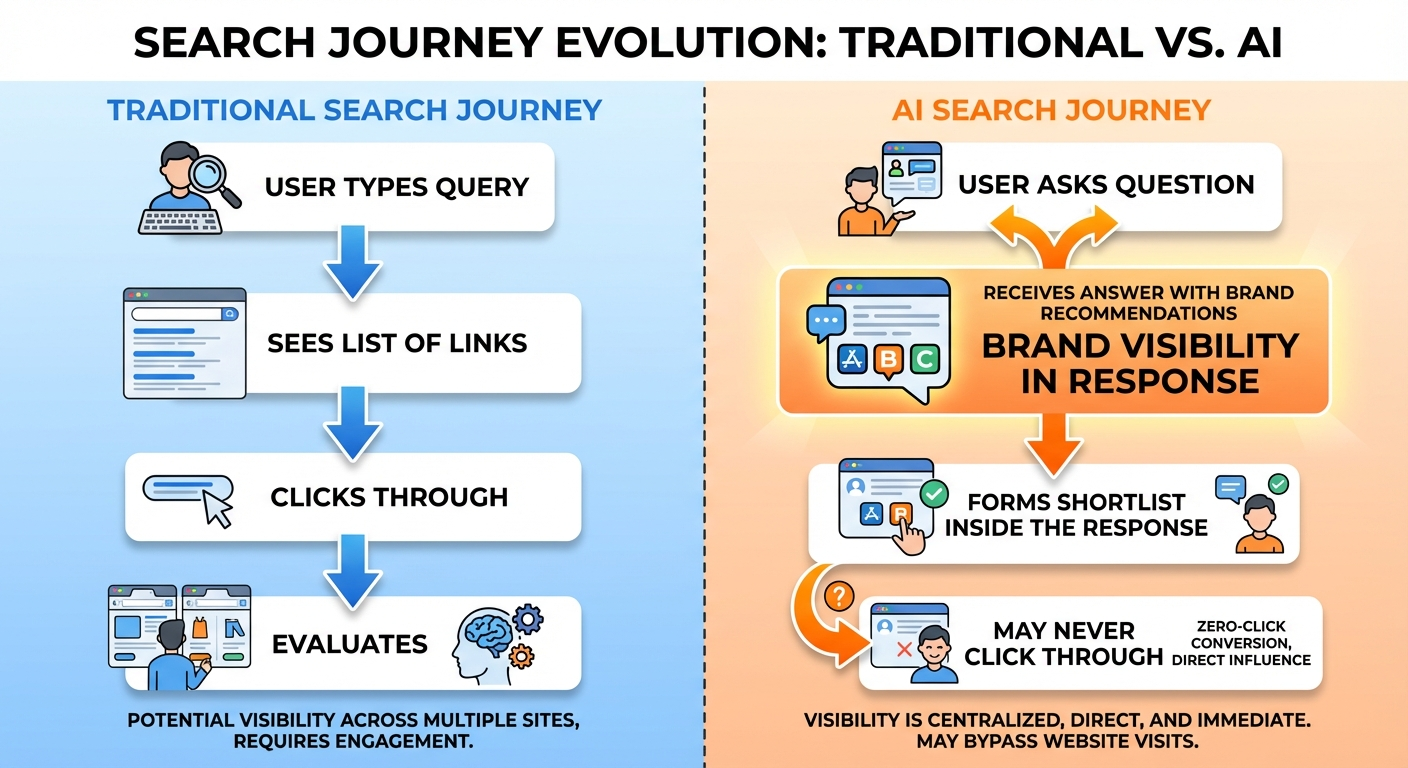
Traditional search gives users a list of links. AI search gives users an answer — often with specific brand recommendations embedded in it. That shift matters because the user’s shortlist gets formed inside the AI response, not on a search engine results page.
ChatGPT processes over 2.5 billion queries per day, according to a February 2026 report from DemandSage. Perplexity surpassed 200 million monthly active visits by late 2025. Google’s AI Overviews now appear in a significant share of commercial queries across the United States.
When someone asks Perplexity “What’s the best CRM for a 50-person sales team?” and your competitor gets named while you don’t — that’s a lost opportunity your analytics dashboard never shows. There is no click to track. No impression to count. The buyer simply moved forward without you.
A Pew Research Center study from 2025 found that approximately 9% of Americans already get news from chatbots. That number is climbing. For product and service research — where purchase intent is high — the share is likely higher, though precise data remains limited.
What an AI Brand Mention Tracking Agency Actually Does
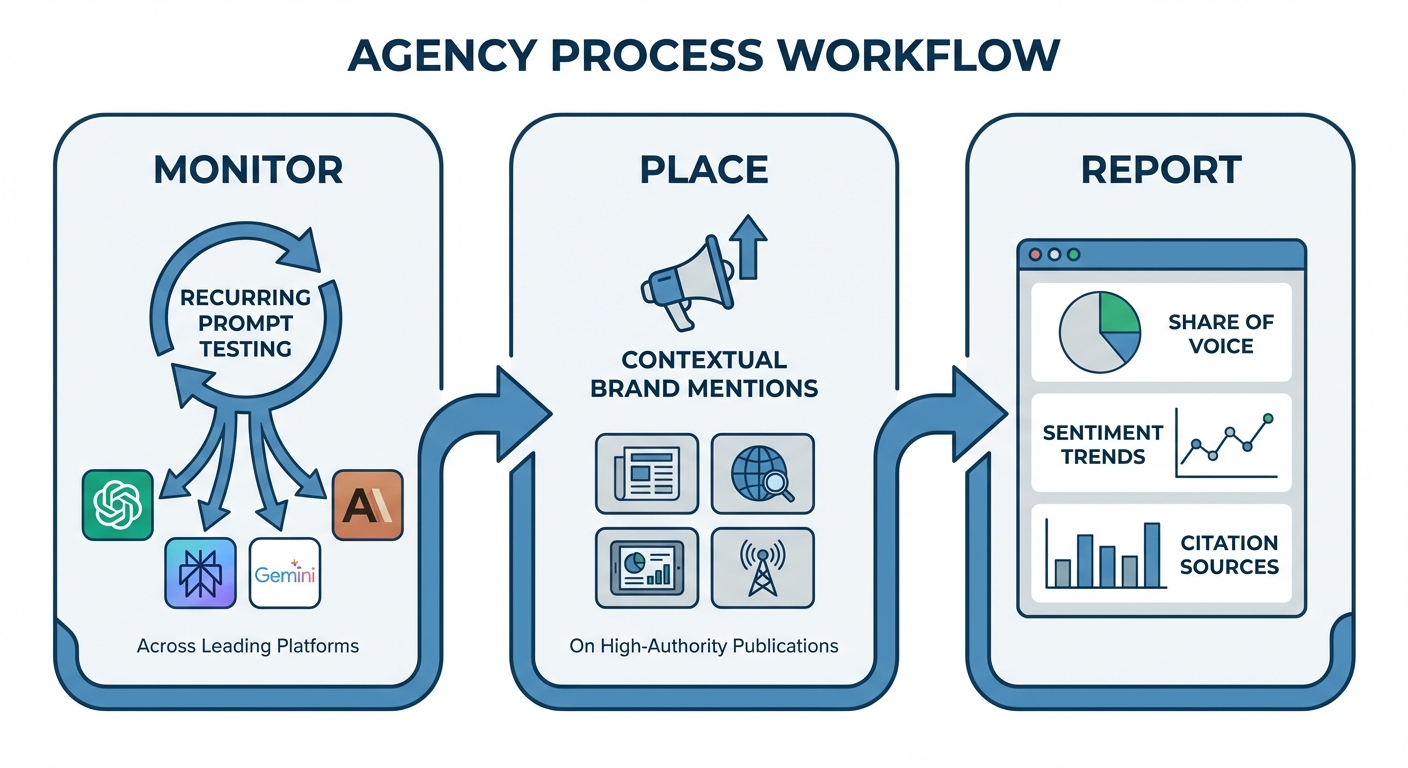
An agency that tracks brand mentions in ChatGPT and Perplexity combines three distinct capabilities that most marketing teams lack individually: AI monitoring, strategic content placement, and citation influence.
Monitoring: Knowing What AI Says About You
The agency runs structured prompt libraries across multiple AI platforms — ChatGPT, Perplexity, Gemini, Claude, and Copilot — to record how each model responds to queries relevant to your category. This is not a one-time check. It is a recurring, systematic process that tracks changes over time.
Monitoring captures three distinct signals:
- Mentions — your brand name appears in the answer text
- Citations — your domain or content appears in the AI’s source references
- Sentiment — how the AI describes your brand (positive, neutral, negative, or inaccurate)
Each signal requires a different response. Being mentioned but not cited means the AI recognizes your entity but doesn’t trust your content enough to source it. Being cited but described negatively means the AI found your content — and also found problems with your reputation.
Placement: Getting Your Brand Into the Sources AI Trusts
AI models build their answers from content they encounter during training or real-time retrieval. The sources they trust tend to be high-authority editorial publications, industry directories, expert roundups, and well-structured product pages.
A brand mention placement agency secures contextual mentions of your brand on publications that AI models actively learn from. This is not link building in the traditional SEO sense. It is about creating the right signals — in the right places — so that when an LLM retrieves information about your category, your brand appears as a credible recommendation.
Agencies like BrandMentions solve this by placing contextual brand mentions across 140+ high-authority publications that AI models actively reference during training and retrieval.
Reporting: Measuring What Changed and Why
The third function is translating monitoring data into actionable reports. Useful reporting includes:
- Share of voice across AI platforms — how often you appear versus competitors for target prompts
- Sentiment trends — whether the tone of your AI mentions is improving or degrading
- Source attribution — which publications or pages the AI cites when recommending your brand
- Gap analysis — prompts where competitors appear but you don’t
How LLMs Decide Which Brands to Recommend
Understanding why an AI mentions one brand over another helps you evaluate whether an agency’s approach is grounded in reality or built on promises.
Large language models select brands for their responses through two primary mechanisms:
Training data influence. Models like GPT-4 and Claude learn brand-category associations from the massive text datasets they were trained on. If your brand appears frequently in authoritative, contextually relevant content across the web, the model internalizes that association. Research published by the Allen Institute for AI in 2024 demonstrated that LLMs develop strong entity-topic associations based on co-occurrence patterns in training corpora.
Retrieval-augmented generation (RAG). Platforms like Perplexity and ChatGPT with web browsing enabled search the live web before generating an answer. They retrieve and synthesize content from sources they consider trustworthy. If your brand is well-represented on high-authority domains that the retrieval system queries, you are more likely to be included.
Key Definition: A brand mention is any instance where a company name appears in editorial content — with or without a hyperlink — on a website that AI models are likely to include in their training data or real-time retrieval.
This means your AI visibility depends on two things: the volume and quality of your brand’s presence across the web, and the recency of that presence relative to model training cutoffs and retrieval windows.
What Separates a Credible Agency from Vendor Noise
The AI visibility space in 2026 is crowded with new entrants, many making claims that outpace their capabilities. Here is how to separate real expertise from marketing.
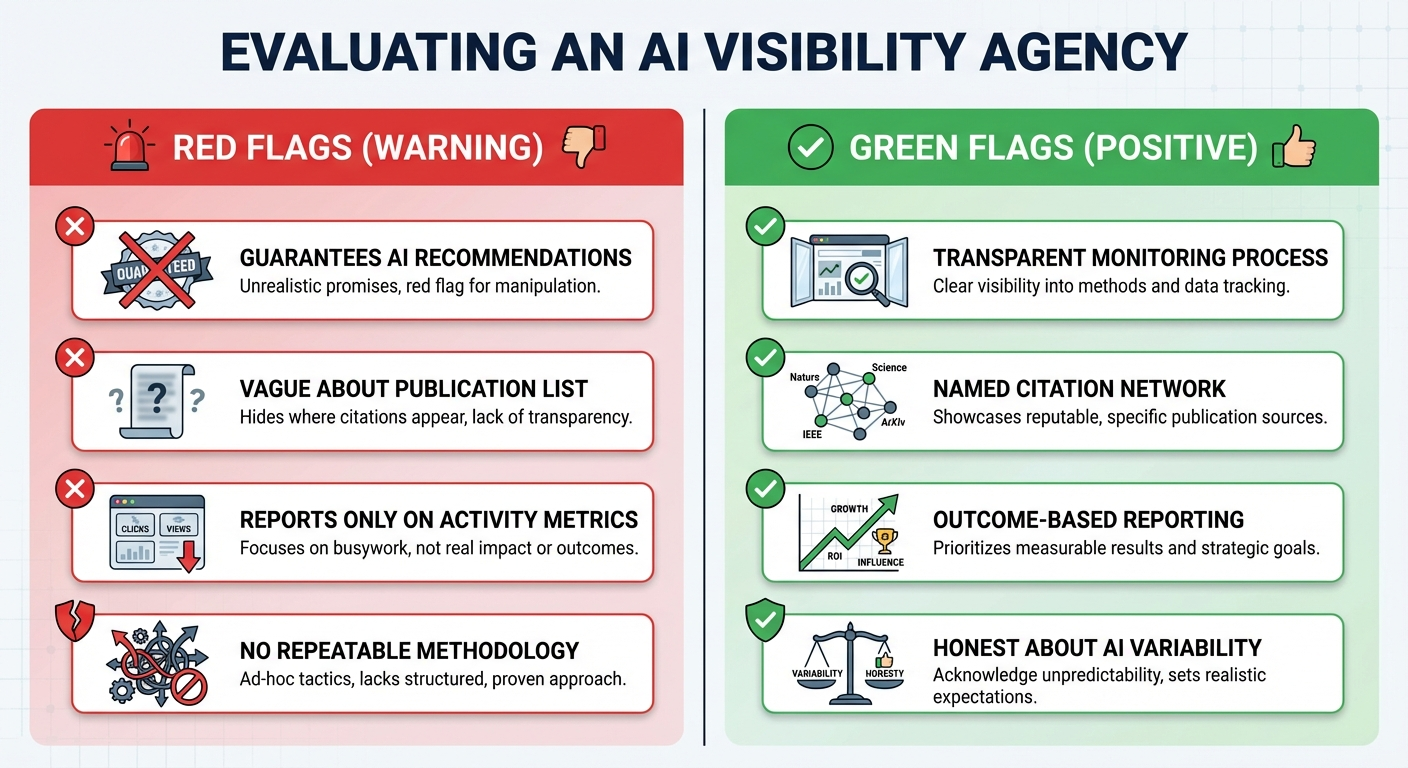
They Show You Their Monitoring Methodology
A credible agency will explain exactly how they test AI responses: which platforms they monitor, how many prompts they run, how they control for variables like location, model version, and personalization, and how often they repeat the process.
If an agency cannot describe its prompt library structure or explain why AI responses vary across sessions, it likely does not have a repeatable measurement system. AI outputs are inherently variable. Reliable tracking requires structured, recurring prompt execution with consistent controls — not occasional manual spot checks.
They Have a Real Citation Network
Ask any prospective agency: where, specifically, will my brand be mentioned? On which publications? With what kind of editorial context?
The answer should be specific. A strong agency maintains relationships with a network of high-authority publications across industries — not a generic list of low-quality sites. The publications should be ones that AI models demonstrably pull from during retrieval.
They Measure Outcomes, Not Just Activity
Placing 50 brand mentions is an activity. Increasing your share of AI recommendations for target prompts by a measurable percentage is an outcome. The agency should report on the latter.
In campaigns across 67+ B2B companies, the BrandMentions team found that brands with consistent editorial mentions achieved AI recommendation rates 89% higher than those relying solely on traditional SEO. That kind of specificity — campaign count, measurable comparison, clear metric — is what you should expect from any agency presenting results.
They Don’t Promise Guaranteed Recommendations
No agency can guarantee that ChatGPT or Perplexity will recommend your brand for a specific query. AI model behavior is probabilistic, not deterministic. Any agency that promises a guaranteed placement in an AI response is either misunderstanding how LLMs work or misrepresenting its capabilities.
What a credible agency can promise: a systematic approach to increasing the probability and frequency of your brand appearing in AI-generated answers, with transparent measurement to track progress.
Core Services to Expect From an AI Visibility Agency
Not every agency offers the same scope. Here is what a comprehensive service stack looks like in 2026, and what each component delivers.
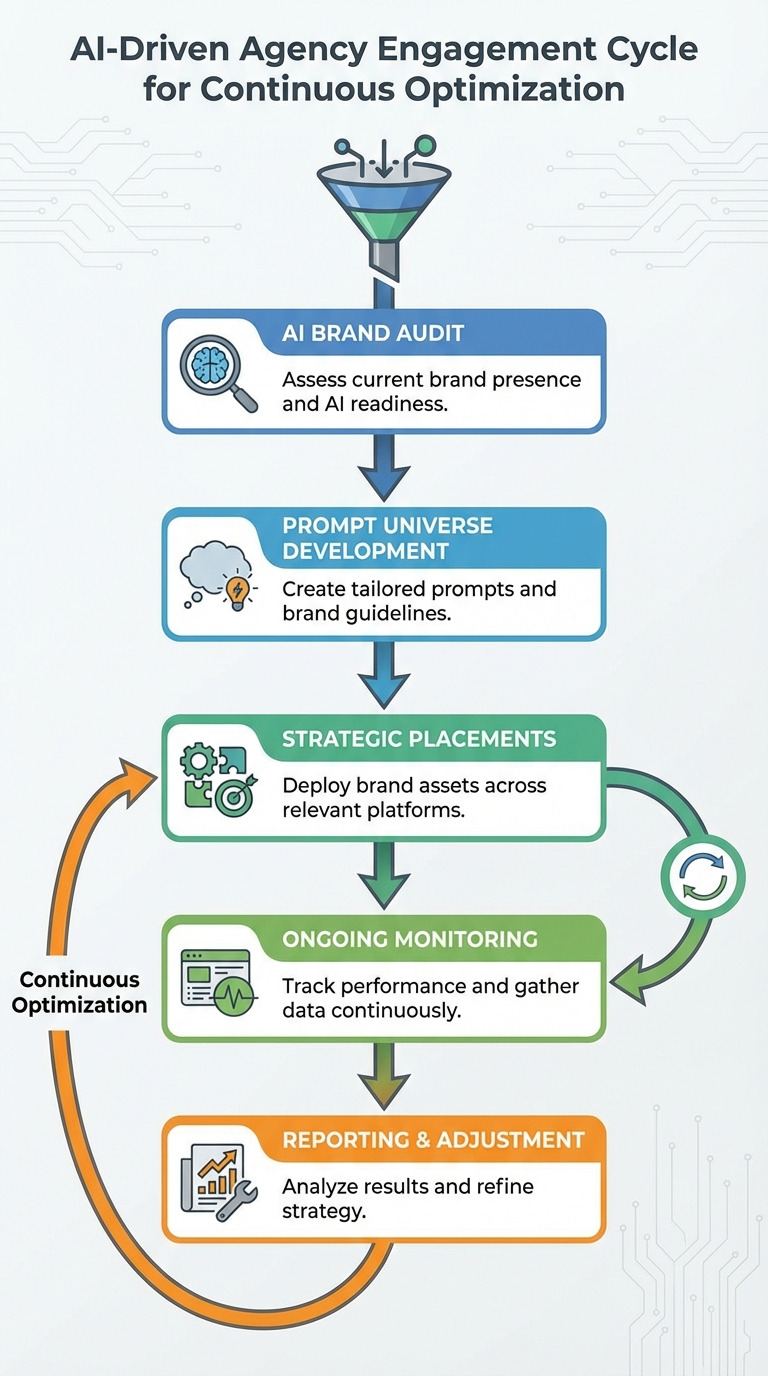
AI Brand Audit
Before any campaign begins, the agency runs a baseline audit across ChatGPT, Perplexity, Gemini, Claude, and other relevant AI platforms. This audit answers: Does the AI recognize your brand? How does it describe you? Where does it rank you against competitors? What sources is it pulling from?
The audit establishes benchmarks so that future results have a clear reference point. Without a baseline, you cannot measure improvement.
Prompt Universe Development
The agency builds a library of prompts that mirror how your target buyers ask AI for recommendations. These are categorized by intent — commercial (“best project management tool for remote teams”), informational (“how does [category] work”), and comparative (“Brand A vs. Brand B”).
A well-built prompt library typically includes 50–200 prompts, depending on the complexity of your product line and the number of competitor entities you want to track.
Strategic Brand Mention Placements
This is the core deliverable. The agency places your brand in contextually relevant editorial content on high-authority publications. Each placement is designed to create a signal that AI models can discover during training or retrieval.
Effective placements share several characteristics:
- Published on domains with high editorial authority
- Contextually relevant to your product category
- Structured so that your brand-category association is clear and specific
- Diverse across publication types (news, industry analysis, expert roundups, product comparisons)
Learn more about how the placement process works and which publication types drive the strongest AI signals.
Ongoing Monitoring and Competitive Tracking
After placements begin, the agency re-runs its prompt library on a regular cadence — typically weekly or biweekly — to measure changes. This includes tracking both your own brand’s visibility and your competitors’ presence.
The monitoring should also flag AI hallucinations — instances where the AI states something factually incorrect about your brand, such as wrong pricing, discontinued features, or inaccurate service descriptions. These errors can influence buyer perceptions and require corrective action.
Reporting and Strategy Adjustment
Monthly or biweekly reports should include quantified visibility metrics, competitive share of voice, sentiment analysis, and strategic recommendations for the next cycle. The best agencies adjust their placement strategy based on what the data reveals — targeting specific prompt gaps where competitors currently dominate.
For a deeper look at tracking capabilities and the best methods for monitoring AI brand mentions, BrandMentions maintains a detailed resource.
When Should You Hire an Agency Versus Doing It In-House?
Not every brand needs an agency for this. The decision depends on your resources, the complexity of your competitive landscape, and how quickly you need results.
In-House May Work If:
- You have a dedicated content or PR team with bandwidth to run manual prompt monitoring weekly
- Your competitive landscape involves fewer than three direct competitors in AI responses
- You already maintain relationships with high-authority publications in your industry
- You are comfortable with a slower ramp — building internal processes typically takes 3–6 months before producing consistent data
An Agency Makes Sense If:
- You operate in a competitive category where multiple brands are actively investing in AI visibility
- You need measurable progress within 60–120 days, not 6+ months
- You lack an existing network of high-authority editorial placements
- You manage multiple products, sub-brands, or regional markets that require scaled monitoring
- Your team lacks experience with prompt-based AI testing methodologies
For early-stage startups, the calculus often tilts toward agency support because establishing entity authority from scratch requires a volume of placements that internal teams struggle to produce quickly. For enterprise brands, the driver is usually scale — monitoring dozens of product lines across multiple AI platforms simultaneously.
Realistic Timelines and What Results Look Like
AI visibility does not produce overnight results. But the timeline is often faster than traditional SEO because the feedback loops are shorter — especially on retrieval-based platforms like Perplexity that pull from the live web.
Month 1: Baseline and Strategy
The agency runs your AI brand audit, builds the prompt library, and identifies your highest-priority gaps. Initial placements begin late in the first month.
Months 2–3: First Measurable Movement
Retrieval-based AI platforms like Perplexity may begin surfacing your brand within weeks of new high-authority placements going live. Training-data-dependent platforms like ChatGPT and Claude take longer because model updates occur on a less frequent schedule.
BrandMentions tracks when major AI models update their training data and times placements to maximize inclusion in each knowledge refresh cycle.
Months 4–6: Compounding Visibility
As placements accumulate across more publications and more content types, your brand’s entity authority strengthens. The AI begins associating your brand with your category more consistently. Share of voice metrics should show measurable gains relative to your baseline.
To see specific outcomes from real campaigns, review the BrandMentions case study library.
Pro Insight: AI visibility compounds over time. Each new high-authority placement reinforces the signals from previous ones. Brands that maintain consistent placement cadence over 6–12 months build a durable advantage that is difficult for competitors to replicate quickly.
How to Evaluate Agencies: A Practical Scoring Framework
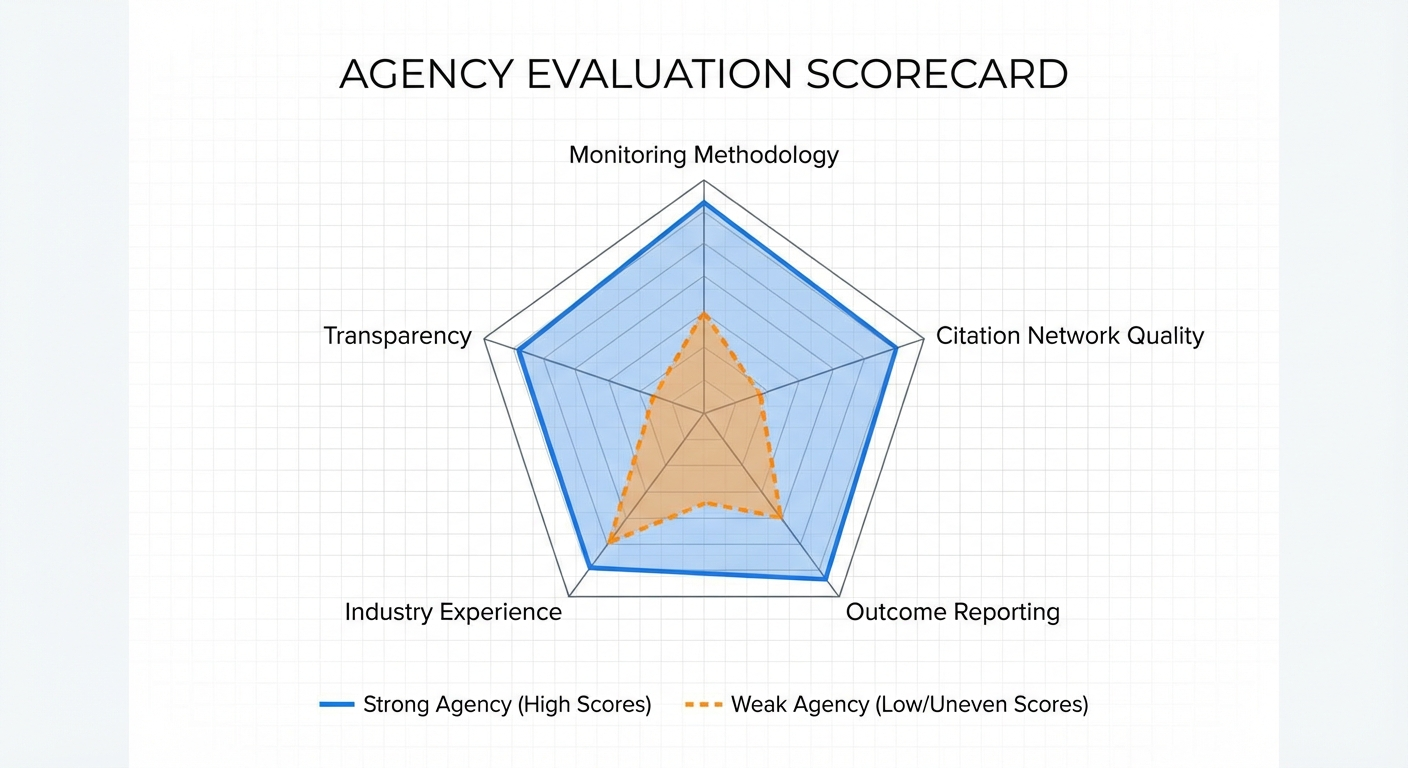
Use these five criteria when comparing agencies. Score each on a 1–5 scale based on what you can verify during the evaluation process.
| Criteria | What to Ask | What “5” Looks Like |
|---|---|---|
| Monitoring methodology | How do you test AI responses? What platforms, how many prompts, what cadence? | Documented prompt library, weekly execution, controlled variables, multi-platform coverage |
| Citation network quality | Which publications will my brand appear on? Can I see the list? | Named, high-authority publications with demonstrated AI model coverage |
| Outcome reporting | What metrics do you report? Show me a sample report. | Share of voice, sentiment trends, citation sources, competitive gaps — not just placement counts |
| Industry experience | Have you worked in my sector? What results did you achieve? | Specific case studies with named metrics and timeframes |
| Transparency about limitations | What can’t you guarantee? Where does AI visibility hit a ceiling? | Honest about AI variability, no guaranteed recommendations, clear about timeline expectations |
Industry-Specific Considerations
AI visibility strategies are not one-size-fits-all. The sources AI models trust, the prompts buyers use, and the competitive dynamics differ significantly across industries.
SaaS and B2B Technology
AI platforms receive a high volume of comparison and recommendation queries in SaaS categories (“best CRM for startups,” “top project management tools for agencies”). Competitive density is high, and AI models frequently cite review platforms, industry publications, and product comparison sites. SaaS-specific AI visibility strategies typically require aggressive competitive tracking and broad publication coverage.
Fintech and Financial Services
AI models apply higher trust thresholds for financial product recommendations. Content from regulatory bodies, established financial publications, and credentialed expert sources carries disproportionate weight. Fintech brands benefit from placements that emphasize regulatory compliance, security credentials, and institutional endorsements.
Healthtech and Healthcare
Similar to fintech, AI platforms exhibit cautious behavior around health-related recommendations. Published clinical evidence, peer-reviewed sources, and recognized healthcare publications are weighted more heavily. Healthtech brands need placements that reinforce clinical credibility and institutional trust signals.
What Has Changed Since 2024–2025
The AI visibility landscape has evolved rapidly. Understanding what changed helps you assess whether an agency’s approach is current.
- Perplexity’s growth accelerated. Between mid-2025 and early 2026, Perplexity’s monthly active users roughly doubled. Its citation-heavy response format makes it the most transparent AI platform for tracking which sources influence answers.
- ChatGPT added persistent web browsing. As of 2026, ChatGPT’s default behavior includes web retrieval for many query types, making real-time content placement more influential than in 2024 when responses relied more heavily on static training data.
- Google AI Overviews expanded. Google’s AI-generated summaries now appear for a broader range of commercial queries in US search results, creating a third major surface — alongside ChatGPT and Perplexity — where brand visibility matters.
- Measurement tools matured. In 2024, most AI visibility tracking was manual. By 2026, several platforms offer automated prompt testing, though the depth and reliability of these tools varies significantly.
These shifts mean that strategies built for 2024 may already be outdated. An agency working in this space should demonstrate awareness of current model behavior, not just general AI concepts.
Frequently Asked Questions
How is an AI visibility agency different from a PR agency or SEO firm?
A traditional PR agency earns media coverage. A traditional SEO firm optimizes for Google’s organic algorithm. An AI visibility agency specifically targets the sources and signals that large language models use to generate brand recommendations. There is overlap in tactics — editorial placements, high-authority content — but the measurement framework, platform focus, and strategic intent are distinct.
Can I track AI brand mentions with free tools?
You can manually query ChatGPT and Perplexity for free. However, manual testing is inconsistent, time-intensive, and does not scale. AI responses vary by session, model version, location, and personalization settings. Reliable tracking requires structured, repeatable prompt execution — which is where dedicated tracking tools or agency services provide significant value.
How long before I see results from an AI visibility campaign?
Most brands see initial movement on retrieval-based platforms like Perplexity within 4–8 weeks of the first placements going live. Training-data-dependent platforms like ChatGPT and Claude may take 3–6 months, depending on model update cycles. Consistent placement over 6–12 months produces the strongest compounding effect.
Does AI visibility replace SEO?
No. AI visibility and SEO are complementary. Strong SEO foundations — structured content, technical health, domain authority — support AI visibility by making your content more discoverable and citable. An AI visibility strategy adds a layer that traditional SEO does not cover: influencing how and whether LLMs recommend your brand in conversational answers.
What if AI says something incorrect about my brand?
AI hallucinations — factually incorrect statements about your brand — are a real risk. Monitoring catches these errors. The corrective action involves publishing accurate, authoritative content on high-trust sources so the AI’s retrieval and training signals are updated. An agency with a strong citation network can accelerate this correction process.
Choosing Your Next Step
If your brand competes in a category where buyers ask AI for recommendations — and in 2026, most B2B categories qualify — then understanding your AI visibility is no longer optional. Whether you build the capability internally or work with a specialized agency depends on your team’s bandwidth, competitive pressure, and how quickly you need measurable movement.
The brands gaining ground right now are the ones treating AI visibility as a strategic channel, not an afterthought. They are investing in systematic monitoring, consistent high-authority placements, and honest measurement of what is working.
If you want to understand where your brand stands today — across ChatGPT, Perplexity, Gemini, and other AI platforms — get your free AI visibility audit and see exactly what AI says about you and your competitors.