AEO tools for improving brand mentions in ChatGPT help you track, analyze, and strengthen how AI platforms reference your brand — giving you a clear path to show up in the answers your buyers actually read. As of 2026, these tools have evolved beyond simple rank trackers into specialized platforms that monitor citation patterns, sentiment, and competitive positioning across multiple large language models simultaneously.
But here’s the problem most marketing teams face: the AEO tooling market has exploded from a handful of options in 2024 to dozens of platforms in 2026, each claiming to solve AI visibility. Choosing the wrong tool wastes budget. Choosing none means flying blind while competitors capture the AI-generated recommendations that increasingly shape B2B purchase decisions.
This article breaks down what AEO tools actually do, which capabilities matter most for improving brand mentions in ChatGPT specifically, and how to evaluate platforms based on your team’s size, budget, and strategic goals — without the vendor hype.
What You’ll Learn
- How AEO tools differ from traditional SEO platforms — and why that distinction matters for ChatGPT visibility
- The specific capabilities that directly influence whether ChatGPT mentions your brand
- A practical evaluation framework for comparing AEO tools against your actual needs
- Which tool categories fit different team sizes, from lean startups to enterprise marketing orgs
- How to connect AEO tool data to content and authority-building actions that improve citations
- Common mistakes that turn AEO tools into expensive, unused dashboards
- How to measure whether your AEO investment is producing real citation improvements over time
How Do AEO Tools Differ From Traditional SEO Platforms?
Answer engine optimization (AEO) tools are specialized platforms designed to monitor and improve your brand’s visibility within AI-generated responses — not traditional search engine results pages. While SEO tools track keyword rankings, backlink profiles, and organic traffic, AEO tools track an entirely different set of signals: whether AI models cite your brand, how they describe it, and which sources they pull from when answering queries related to your category.
This distinction is more than semantic. ChatGPT, Perplexity, Claude, and Gemini don’t rank pages in a list. They synthesize answers from multiple sources and decide which brands to name based on perceived authority, consistency of information across the web, and the structure of available content. Traditional SEO platforms weren’t built to capture these dynamics.
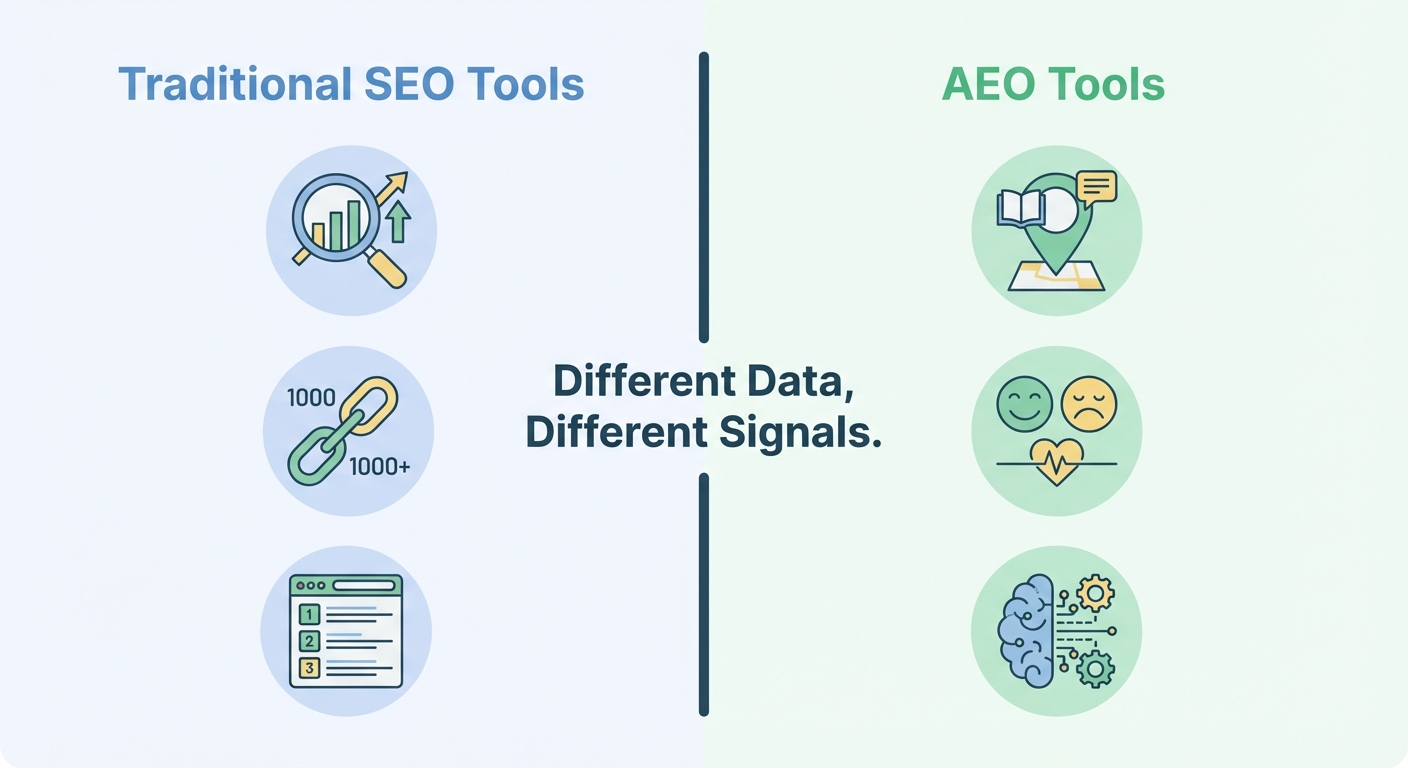
Here’s where the functional differences show up:
- Data source: SEO tools pull from search engine indexes. AEO tools query live AI models and record their responses.
- Success metric: SEO measures clicks and impressions. AEO measures citation frequency, sentiment, and share of voice within AI answers.
- Optimization target: SEO optimizes for keyword relevance and link equity. AEO optimizes for entity recognition, structured extractability, and cross-platform brand consistency.
- Competitive insight: SEO shows who ranks above you. AEO shows who gets recommended instead of you — and why.
If you’re already investing in traditional SEO, that foundation matters. Content quality, technical health, and domain authority still influence what AI models learn from the web. But tracking whether that investment translates into actual ChatGPT mentions requires a different instrument. That’s what AEO tools provide.
For a deeper look at how brand mentions function across AI platforms beyond ChatGPT, see how brand mentions in generative AI work across different model architectures.
Which AEO Capabilities Actually Improve ChatGPT Brand Mentions?
Not every feature in an AEO tool directly influences whether ChatGPT cites your brand. Some features are diagnostic — they show you what’s happening. Others are strategic — they guide what to do about it. Understanding the difference prevents you from paying for dashboards that look impressive but don’t move citation rates.
Multi-Model Citation Tracking
The most foundational capability. Citation tracking records whether your brand appears in AI-generated responses across ChatGPT, Perplexity, Gemini, Claude, Copilot, and other models. It distinguishes between direct mentions (where the AI names your brand), indirect references (where it paraphrases your content without attribution), and competitive citations (where a rival gets the recommendation instead).
Why this matters for ChatGPT specifically: ChatGPT’s citation behavior has shifted since 2024. With the expansion of its web browsing and retrieval-augmented generation (RAG) capabilities — where the model pulls real-time information from search indexes to formulate answers — tracking which sources it references and how often gives you a direct feedback loop on your content’s authority in the model’s eyes.
Key definition: Retrieval-augmented generation (RAG) is the process where an AI model supplements its trained knowledge by pulling fresh information from external sources — like web pages — at the moment it generates a response.
Tools that only track one or two AI platforms leave gaps. A brand might appear in Perplexity responses but be absent from ChatGPT entirely, or vice versa. Multi-model tracking reveals these asymmetries so you can prioritize the platform where your audience actually searches.
If you want to monitor brand mentions in ChatGPT with greater precision, look for tools that capture response screenshots or store raw outputs for verification.
Prompt and Query Analysis
Understanding what users are asking AI models about your category is just as valuable as knowing whether you appear in the answers. Prompt analysis features reveal the actual queries that trigger brand mentions — or fail to trigger them.
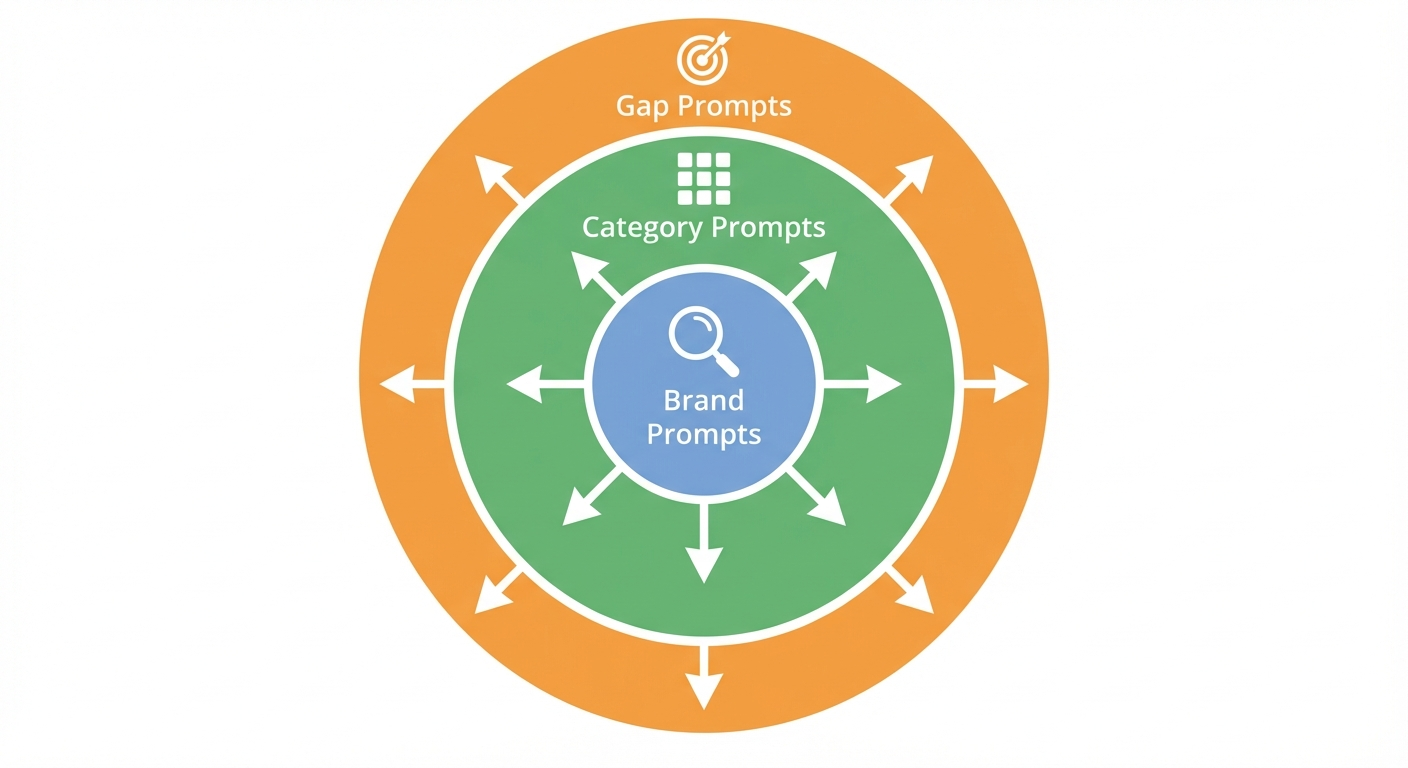
Strong AEO tools surface:
- High-volume prompts in your category — the questions users ask most frequently
- Gap prompts — queries where competitors appear but you don’t
- Brand-specific prompts — how users ask about you directly (e.g., “[Your Brand] vs. [Competitor]” or “Is [Your Brand] good for [use case]?”)
This data shapes your content strategy. If thousands of users ask ChatGPT “What’s the best project management tool for remote teams?” and your brand never appears, you know exactly which content gap to fill.
Sentiment and Narrative Monitoring
Being mentioned isn’t enough. How ChatGPT describes your brand determines whether that mention builds trust or erodes it. Sentiment monitoring evaluates whether AI platforms frame your brand positively, neutrally, or negatively — and flags specific language patterns you should address.
For example, if ChatGPT consistently describes your product as “affordable but limited,” that narrative directly influences how prospects perceive you before they ever visit your website. Sentiment tools catch this so you can correct the underlying content signals.
According to a 2025 Edelman Trust Barometer report, 63% of respondents said they trust information provided by AI assistants as much as or more than traditional search results. That makes the tone of AI-generated brand mentions a genuine reputation factor — not just a vanity metric.
Competitive Share of Voice
Share of voice in AEO measures your brand’s presence relative to competitors across a defined set of prompts. If you track 100 category-relevant prompts and your brand appears in 12 while your top competitor appears in 38, you have a clear picture of the visibility gap.
This metric is more actionable than raw citation counts because it’s contextual. A brand with 50 total mentions but low share of voice on high-intent purchase prompts is worse off than a brand with 20 mentions concentrated on decision-stage queries.
For competitive tracking methods across multiple AI models, see how to track brand mentions across AI search platforms.
Source Attribution and Citation Path Analysis
When ChatGPT mentions a brand, it draws that information from somewhere — typically high-authority web pages, recent publications, or structured data sources it accessed during retrieval. Source attribution features in AEO tools show you which specific URLs AI models reference when citing your brand or competitors.
This is where AEO data becomes directly actionable:
- If ChatGPT cites a competitor because of a single authoritative article on a tier-1 publication, you know where to focus your editorial outreach.
- If your own product page is being cited but with outdated information, you know what to update.
- If AI models consistently reference the same five domains in your category, those are the publications where brand mentions in AI carry the most weight.
How to Evaluate AEO Tools for Your Team’s Needs
The AEO market in 2026 includes everything from free graders to enterprise platforms exceeding $1,000 per month. Choosing the right tool depends less on feature counts and more on how well the tool fits your team’s actual workflow, budget, and strategic maturity.
Map Your Current AI Visibility Baseline
Before evaluating any tool, establish where you stand. Run your brand name through ChatGPT, Perplexity, and Gemini with 10–20 category-relevant prompts. Record whether you’re mentioned, in what context, and which competitors appear instead.
This manual baseline takes about an hour and tells you two things:
- How urgently you need AEO tooling — if you’re already appearing frequently, you need optimization. If you’re absent, you need foundational visibility work first.
- What type of tool you need — diagnostic (tracking and analysis), strategic (content guidance and optimization), or both.
Several BrandMentions campaigns across B2B SaaS companies have shown that brands with fewer than 5 mentions across 50 tracked prompts typically benefit more from investing in content and citation network development before adding advanced tracking software.
Match Tool Complexity to Team Capacity
An enterprise AEO platform with predictive analytics, AI crawler log monitoring, and custom API integrations adds no value if your marketing team has two people and no data analyst. Conversely, a lightweight tool that only offers basic visibility scores will frustrate a 20-person growth team that needs granular prompt-level data.
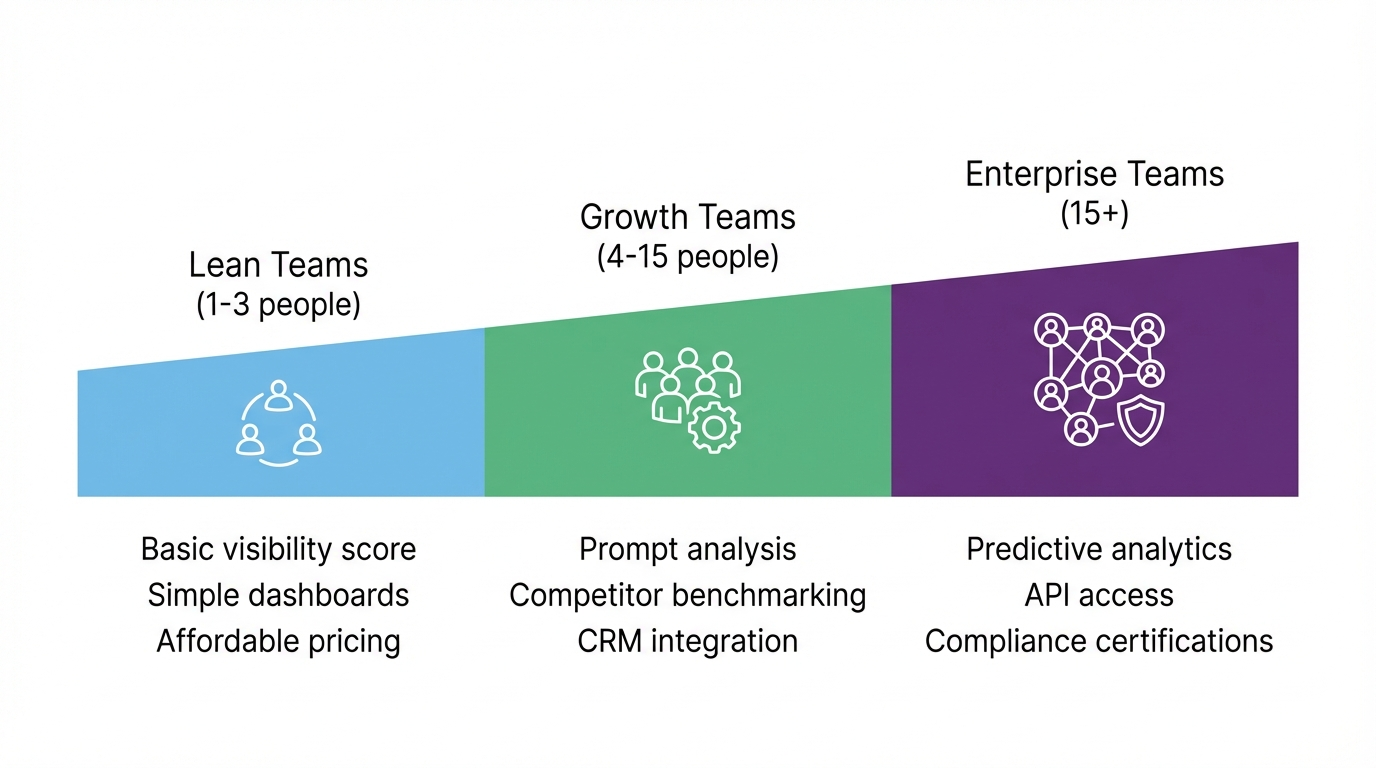
Use this as a rough matching framework:
- Teams of 1–3 (startups, solopreneurs): Prioritize tools with clear dashboards, pre-built prompt libraries, and pricing under $100/month. You need actionable data without a steep learning curve.
- Teams of 4–15 (growth-stage companies): Look for prompt-level analysis, competitive benchmarking, content optimization recommendations, and CRM or analytics integrations. Budget range: $200–$600/month.
- Teams of 15+ (enterprise): Evaluate platforms with SOC 2 compliance, role-based access, API connectivity, custom reporting, and dedicated support. Budget range: $500–$2,000+/month.
Prioritize Actionability Over Data Volume
The most common complaint about AEO tools isn’t that they lack data — it’s that teams don’t know what to do with the data. A tool that tells you “your share of voice is 11%” without explaining why or what to change creates anxiety, not progress.
When evaluating platforms, ask these questions:
- Does the tool explain why a competitor is being cited over my brand?
- Does it recommend specific content changes, publication targets, or structural improvements?
- Can I trace a citation back to its source URL and understand what made that content extractable by AI?
- Does the platform connect visibility data to downstream metrics like traffic, leads, or pipeline?
Tools that answer these questions turn AEO monitoring from a passive exercise into an active growth lever.
What AEO Tool Categories Exist in 2026?
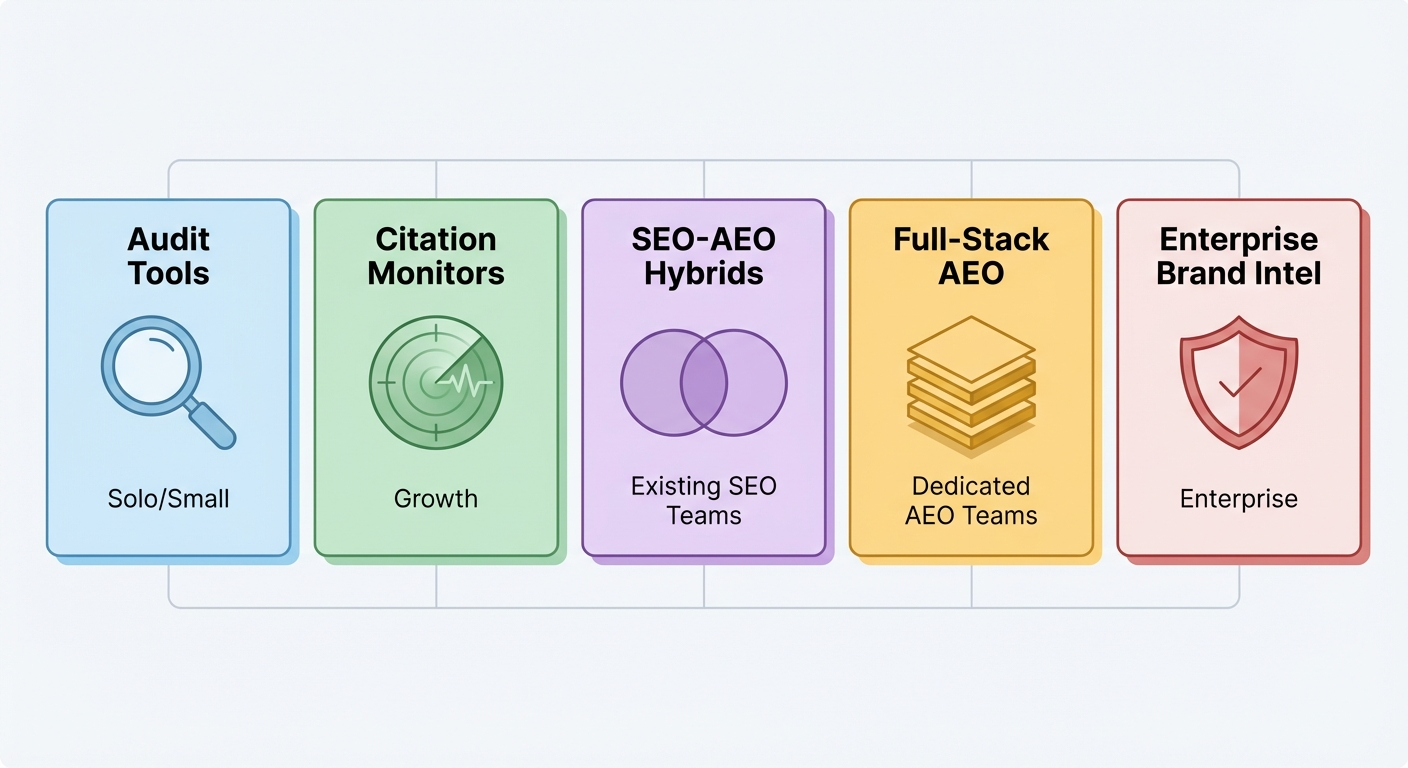
Rather than reviewing individual tools (which shift pricing and features quarterly), understanding the categories helps you identify what type of platform solves your specific problem. As of 2026, AEO tools fall into five functional categories, each serving a different strategic need.
AI Visibility Graders and Audit Tools
What they do: Provide a snapshot assessment of your brand’s current presence across AI platforms. Typically free or low-cost. They answer the question: “Does AI know my brand exists?”
Best for: Initial baseline assessment, executive buy-in, teams considering AEO investment.
Limitations: Static snapshots, no ongoing tracking, limited competitive depth. Think of these as a starting point, not a strategy tool.
Citation Monitoring Platforms
What they do: Continuously track when and how your brand appears in AI responses across multiple models. They record mention frequency, source URLs, sentiment, and competitor comparisons.
Best for: Teams that need ongoing visibility data to inform content and PR decisions.
Limitations: Strong on diagnostics, sometimes weak on prescriptive guidance. You see the problem clearly but may need separate resources to solve it. For deeper tracking methodology, explore how to track brand mentions in large language models systematically.
SEO-AEO Hybrid Platforms
What they do: Extend traditional SEO suites with AI visibility features — bolt-on modules that add ChatGPT and Perplexity tracking alongside existing keyword and backlink tools.
Best for: Teams already invested in SEO platforms (Ahrefs, Semrush, Surfer SEO) who want to layer AI visibility without adding another vendor.
Limitations: AI features are secondary to the core SEO product. Coverage across AI models may be narrower than dedicated AEO platforms. Prompt-level analysis is often less sophisticated.
Full-Stack AEO Optimization Platforms
What they do: Combine monitoring with content optimization, prompt discovery, competitive intelligence, and sometimes content generation. These platforms aim to be the single tool for AI visibility strategy.
Best for: Growth and enterprise teams running structured AEO programs with dedicated resources.
Limitations: Higher cost, steeper learning curves, potential for feature bloat. Evaluate whether you’ll actually use the full feature set before committing.
Enterprise Brand Intelligence Platforms
What they do: Focus on brand reputation and accuracy monitoring across AI systems. These platforms emphasize detecting misinformation, tracking narrative shifts, and ensuring AI models describe your brand correctly.
Best for: Fortune 500 brands, regulated industries (healthcare, finance), companies with significant reputational exposure.
Limitations: Often expensive, require dedicated analysts, may not provide granular content optimization guidance.
How to Connect AEO Tool Data to Actual Citation Improvements
AEO tools generate data. But data alone doesn’t improve your brand’s appearance in ChatGPT. The tools become valuable when their insights drive specific actions in content creation, editorial placement, and entity authority building.
Use Gap Analysis to Prioritize Content Creation
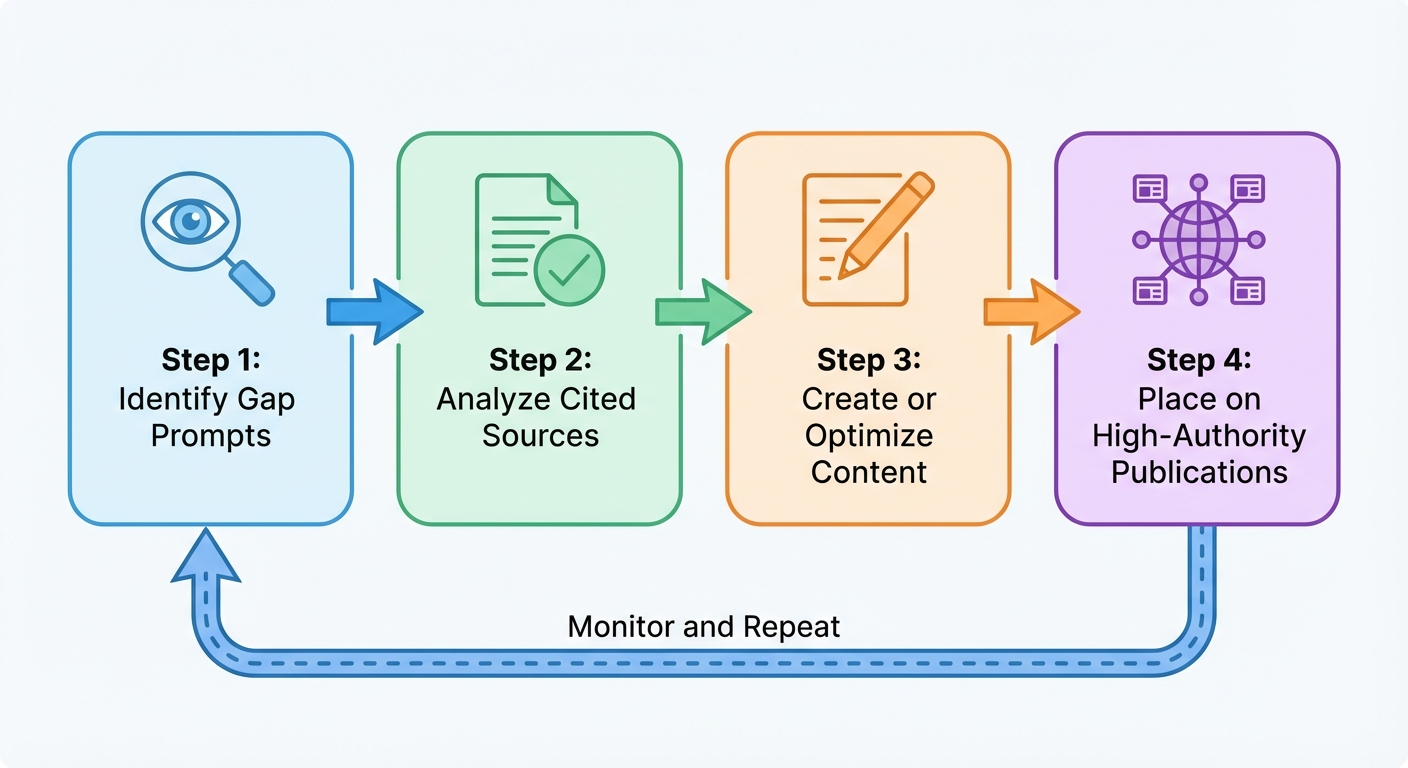
The highest-value output from any AEO tool is gap identification: prompts where your competitors are cited and you are not. These gaps represent the clearest opportunities for improvement.
For each identified gap prompt:
- Analyze the competitor content being cited. What format is it in? How is it structured? Where was it published?
- Assess your existing content. Do you have a page that addresses the same topic? If so, does it answer the query directly in its opening sentences?
- Create or optimize content that provides a more complete, structured, and extractable answer than what currently exists.
This process turns AEO monitoring into a content production roadmap. Instead of guessing which topics to cover, you’re working from verified demand data.
Strengthen Entity Recognition Through Consistent Mentions
AEO tools often reveal a pattern: brands that appear consistently in ChatGPT have dense, consistent mentions across high-authority publications. The model doesn’t learn your brand from a single article — it builds entity associations from repeated exposure across trusted sources.
In campaigns managed by agencies like BrandMentions, brands with contextual editorial mentions across 140+ high-authority publications that AI models actively learn from during training cycles have shown measurably higher citation rates within 2–4 months. The key factor is consistency of entity description — your brand needs to be associated with the same category, use cases, and value propositions across multiple independent sources.
For B2B SaaS companies specifically, see how SaaS brand mentions build the entity authority that AI models rely on when generating recommendations.
Improve Content Structure for AI Extraction
If your AEO tool shows that your content is being crawled by AI systems but not cited, the issue is often structural. AI models prefer content that:
- Leads with a direct answer in 1–3 sentences immediately after a question heading
- Uses clear entity names (brand, product, category) instead of pronouns
- Includes structured formats — numbered steps, comparison tables, definition blocks — that models can extract cleanly
- Contains specific, data-backed claims with source attribution
Review the pages your AEO tool identifies as frequently crawled but rarely cited. Compare their structure against the pages that are being cited by competitors. The structural differences often reveal exactly what to fix.
Pro insight: According to research from the Allen Institute for AI, published in 2024, language models assign higher citation probability to content that contains named entities with clear relational context — for example, “[Brand] is a [category] platform used by [audience] to [outcome]” — compared to content that buries the same information in dense paragraphs.
Monitor Source Authority to Guide Placement Strategy
AEO tools that show source attribution reveal which publications AI models trust most in your category. If ChatGPT consistently pulls from three industry publications when answering questions about your market, those publications become priority targets for editorial placement.
This insight is especially valuable because it’s specific to your category. The publications AI trusts for B2B marketing software may differ entirely from those it trusts for healthcare technology. AEO data replaces guesswork with evidence-based placement decisions.
For more on how editorial placements across AI-trusted publications build citation authority, explore how the BrandMentions placement process works.
Common Mistakes That Waste AEO Tool Investment
The AEO tool market is young enough that most teams are still learning how to use these platforms effectively. These are the mistakes that show up most frequently — and each one can turn a promising AEO investment into shelfware.
Tracking Without a Content Response Plan
The most pervasive mistake: teams purchase AEO tools, generate reports showing low visibility, then do nothing with the data. A visibility score of 8% is only useful if it triggers a content creation sprint, an editorial outreach push, or a structural optimization initiative.
Fix: Before buying any tool, define your response protocol. When the tool identifies a gap prompt, who on your team is responsible for creating content to address it? What’s the turnaround time? Without this workflow, AEO tools become expensive mirrors showing a problem you’re not solving.
Optimizing for Every AI Model Equally
ChatGPT, Perplexity, Claude, Gemini, Copilot, and emerging models each have different retrieval methods and citation behaviors. Trying to optimize for all of them simultaneously dilutes your effort.
Fix: Identify the 2–3 AI platforms your target audience uses most. For most B2B SaaS companies in 2026, that’s ChatGPT and Perplexity, with Google AI Overviews as a third priority. Concentrate optimization there first, then expand. Your AEO tool should support this prioritization, not encourage you to chase every model equally.
Ignoring Technical Accessibility
If AI crawlers can’t access your content, no amount of AEO tool sophistication will help. Some brands block GPTBot, GoogleOther, or Anthropic’s crawler in their robots.txt without realizing it. Others rely on client-side JavaScript rendering that AI crawlers can’t process.
Fix: Confirm that your robots.txt allows AI crawlers and that your pages render server-side. Several AEO tools include crawler analytics that show which AI bots access your site and how frequently — use this data to diagnose technical barriers before investing in content optimization.
Confusing AI Visibility With AI Influence
High visibility scores feel good but don’t always translate to business outcomes. A brand that appears in 40 AI-generated responses about general industry topics but zero responses to high-intent purchase queries has visibility without influence.
Fix: Segment your tracked prompts by buyer intent. Weight your AEO reporting toward decision-stage queries — prompts where users are comparing solutions, asking for recommendations, or evaluating specific features. That’s where AI mentions translate into pipeline.
How to Measure Whether AEO Tools Are Producing Results
Measurement in AEO is still maturing as a discipline, but there are clear signals that your tool investment is paying off — and clear signals that it isn’t.
Leading Indicators (Visible in Weeks 2–8)
- Gap prompt reduction: The number of prompts where competitors appear and you don’t should decrease as you publish optimized content.
- Citation frequency increase: Track absolute mention count month-over-month. Even small increases (from 3 mentions to 8 across 100 prompts) indicate forward momentum.
- Source URL diversification: AI models should begin citing more of your pages over time, not just one or two assets.
Lagging Indicators (Visible in Months 3–6)
- Share of voice improvement: Your percentage of total mentions relative to competitors should trend upward on priority prompts.
- Sentiment improvement: Positive or neutral descriptions should increase as you fix content inconsistencies and outdated information.
- Referral traffic from AI platforms: While attribution is imperfect, direct traffic increases and new referral patterns often correlate with improved AI visibility.
In BrandMentions’ experience across 67+ B2B campaigns, brands that combined consistent editorial placements with AEO tool monitoring saw measurable citation improvements within 90 days — with compounding gains over 6 months as AI models incorporated updated training data and real-time retrieval sources.
When to Re-Evaluate Your Tool
If you’ve used an AEO tool for 90 days and cannot connect its data to at least one content decision that improved your citation rate, the tool isn’t the right fit. Either it lacks the actionability features your team needs, or your team lacks the process to act on the insights.
Both are fixable — but only if you diagnose the problem honestly.
For ongoing tracking best practices, see the best ways to track brand mentions in AI search.
What Has Changed in AEO Tooling Since 2024?
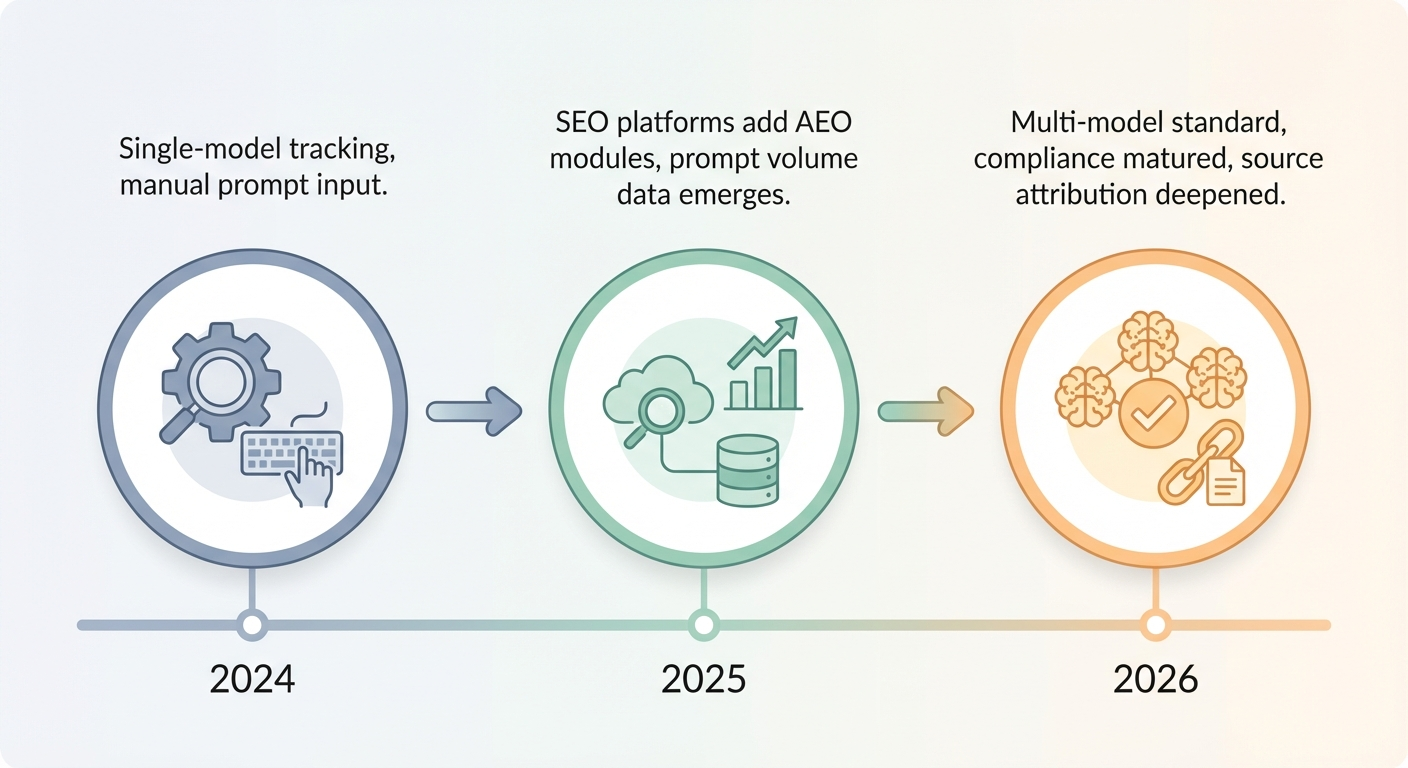
The AEO tool landscape in 2026 looks dramatically different from where it started. Understanding these shifts helps you evaluate tools with current — not outdated — expectations.
- Multi-model coverage became standard. In 2024, most tools tracked only ChatGPT or Google AI Overviews. By 2026, competitive platforms track 8–12 AI models simultaneously, including Claude, Perplexity, Gemini, Copilot, Grok, DeepSeek, and Meta AI.
- Prompt volume data emerged. Early tools required you to manually input prompts to track. Leading platforms now surface real user prompt data — what people are actually asking AI models — based on databases of hundreds of millions of real interactions.
- SEO platforms added AEO modules. Ahrefs (Brand Radar), Semrush (AI Visibility Toolkit), and Surfer SEO (AI Tracker) all launched AEO features between late 2024 and mid-2025, reducing the need for standalone tools for teams already in those ecosystems.
- Compliance matured. Enterprise-grade platforms introduced SOC 2 Type II certification, GDPR readiness, and HIPAA compliance — critical for regulated industries adopting AEO tracking.
- Source attribution deepened. Newer tools don’t just show that you were cited — they show which URL was cited and which publication the model pulled from, enabling precise editorial strategy adjustments.
The pace of change suggests that any tool evaluation you do today may need revisiting in 6–9 months. Build flexibility into your vendor agreements accordingly.
For broader context on how AI-generated citations work and what influences them, see the BrandMentions resource library.
Frequently Asked Questions
Do AEO tools guarantee that ChatGPT will mention my brand?
No tool can guarantee AI mentions. AEO tools provide the data and insights you need to understand why you’re not being cited and what actions to take. The actual citation improvement comes from better content, stronger entity authority, and strategic editorial placements — the tools help you measure and guide that work.
Can I use an AEO tool if I haven’t invested in traditional SEO yet?
You can, but you’ll likely get more value by establishing basic SEO foundations first. ChatGPT and other AI models rely on search engine indexes and web crawling to discover content. If search engines can’t find and index your pages, AI platforms won’t cite them either. Start with technical SEO and content quality, then layer AEO tracking on top.
How many prompts should I track to get useful AEO data?
Start with 30–50 prompts distributed across brand queries, category queries, and competitor comparison queries. This provides enough data to identify patterns without overwhelming a small team. Scale to 100–200 prompts once you’ve validated which prompt categories yield the most actionable insights for your content strategy.
Is there a meaningful difference between free and paid AEO tools?
Free tools provide snapshots — useful for establishing a baseline and building internal support for AEO investment. Paid tools provide ongoing tracking, competitive benchmarking, sentiment analysis, and source attribution that enable strategic decision-making over time. If you’re treating AEO as an ongoing program rather than a one-time audit, paid tools deliver significantly more value.
How often should I check my AEO dashboard?
Weekly reviews work well for most growth-stage teams — frequent enough to catch shifts in citation patterns, infrequent enough to allow time between data reviews and content actions. Daily monitoring makes sense only if you’re running active campaigns or have recently published a wave of optimized content and want to measure response.
Your Next Step: Build the System, Not Just the Stack
AEO tools for improving brand mentions in ChatGPT are one component of a broader AI visibility system. The tool tracks and diagnoses. Your content, editorial placements, and entity authority are what actually drive citations. The most effective teams treat AEO tools as the measurement layer that validates whether their content and placement strategy is working — not as a replacement for that strategy.
Start by establishing your baseline visibility. Choose a tool that matches your team’s capacity and budget. Build a response workflow so every insight from the tool translates into a content or placement action. Then measure, adjust, and compound.
If you want to understand where your brand currently stands in AI-generated recommendations across ChatGPT, Perplexity, and Gemini — and identify the specific gaps where competitors are capturing your audience — request a free AI visibility audit from BrandMentions.