Geo-targeted AI brand mentions require more than generic monitoring — they demand tools built for regional prompt variation, local entity signals, and market-specific citation behavior. As of 2026, the gap between brands that track AI visibility globally and those that measure it at the geo level is widening fast. If your competitors show up when someone in Dallas asks ChatGPT for a recommendation but you only appear in broad, unlocalized results, you’re losing pipeline you can’t even see.
This article breaks down the advanced tools and workflows that let B2B teams track, measure, and strengthen geo-specific brand mentions across AI search platforms — from ChatGPT and Perplexity to Google AI Overviews and Gemini. You’ll learn what changed since 2024–2025, which tools handle regional AI visibility best, and how to build a system that scales across markets.
Key Takeaways
- Geo-targeted AI brand mention tracking requires tools that support location-specific prompt libraries and regional citation analysis — not just global mention counts.
- AI models respond differently to the same query depending on implied or explicit geographic context, making geo-segmented monitoring essential for multi-market brands.
- The most effective 2026 workflows combine prompt-level geo tracking with entity disambiguation, source attribution, and competitive share-of-answer analysis per region.
- Agencies like BrandMentions approach this by placing contextual brand mentions on high-authority publications with regional editorial relevance, improving how AI models associate brands with specific markets.
- False positives multiply in geo-segmented tracking — a structured reliability framework prevents inflated dashboards and wasted effort.
- No single tool covers every geo-AI monitoring need. The strongest stacks pair a dedicated AI visibility tracker with a strategic placement layer that feeds new signals into model training data.
Why Geo Matters for AI-Generated Brand Mentions
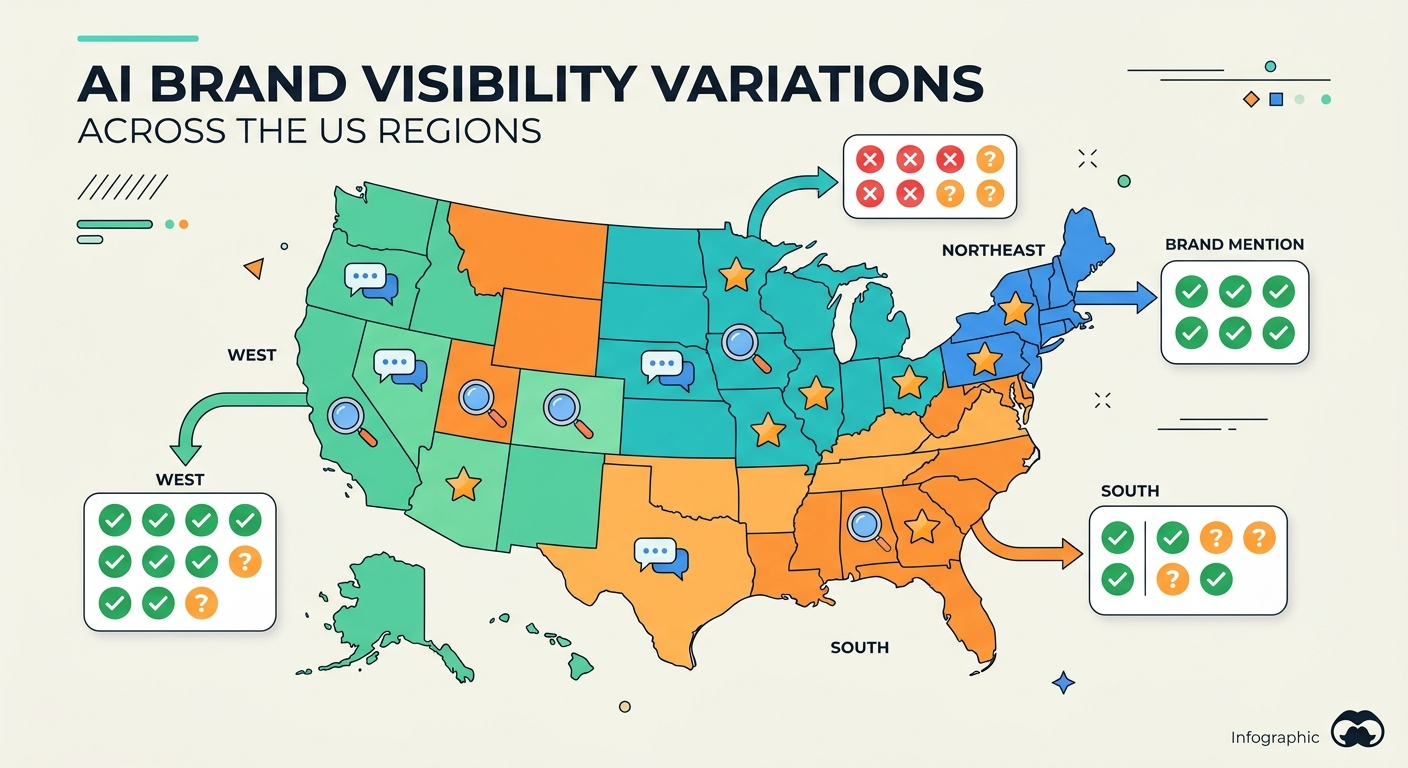
AI search engines don’t just synthesize information — they contextualize it. When a user in Chicago asks Perplexity “best B2B marketing agency near me,” the response draws from a different source pool than the same query from London or Sydney. Google AI Overviews incorporate location signals from the searcher’s IP and query phrasing. ChatGPT’s browsing mode pulls from regionally relevant web results.
This means your brand can be highly visible in AI answers for one metro area and completely absent in another — even for identical queries.
A 2025 BrightEdge analysis found that Google AI Overviews triggered on over 13% of search results pages, with significant variation in which brands appeared based on the searcher’s geographic context. By early 2026, that variation has deepened as AI models incorporate more granular local signals from directories, regional publications, and geo-tagged reviews.
For B2B brands operating across multiple U.S. markets — or expanding internationally — tracking AI mentions without a geo layer is like measuring SEO traffic without segmenting by country. The aggregate number looks fine, but it hides critical gaps.
What Changed Between 2024 and 2026 in Geo AI Visibility
Two years ago, geo-targeted AI mention tracking barely existed as a category. Most early GEO tools — Otterly, Peec AI, the first Semrush AI integrations — focused on global prompt monitoring. You’d run a prompt, see if your brand appeared, and track changes over time. Geography wasn’t a variable.
Three shifts since then have made geo-specific tracking both possible and necessary:
1. AI models now use location as a ranking signal
ChatGPT with browsing, Perplexity, and Google AI Overviews all incorporate user location or explicit geo modifiers when generating answers. A prompt like “best cybersecurity firm for healthcare” returns different recommendations depending on where the user is — or whether they append “in Texas” or “in the Northeast.” This mirrors how traditional local SEO works, but the optimization levers are different.
2. Regional editorial mentions influence AI training data
AI models learn brand-category associations from the content they’re trained on and retrieve in real time. A brand mentioned consistently in Boston Business Journal, regional tech blogs, and state-level industry publications builds stronger geo-specific entity signals than one mentioned only on national platforms. BrandMentions tracks when major AI models update their training data and times placements to maximize inclusion in each knowledge refresh cycle — a process that increasingly favors geo-relevant editorial sources.
3. Tools caught up to the need
By mid-2025, several platforms added geo-filtering to their prompt libraries. In 2026, the most advanced tools support location-specific prompt variants, regional competitive benchmarking, and source attribution filtered by geographic relevance. The tooling finally matches the complexity of the problem.
How to Evaluate Tools for Geo AI Brand Mention Tracking
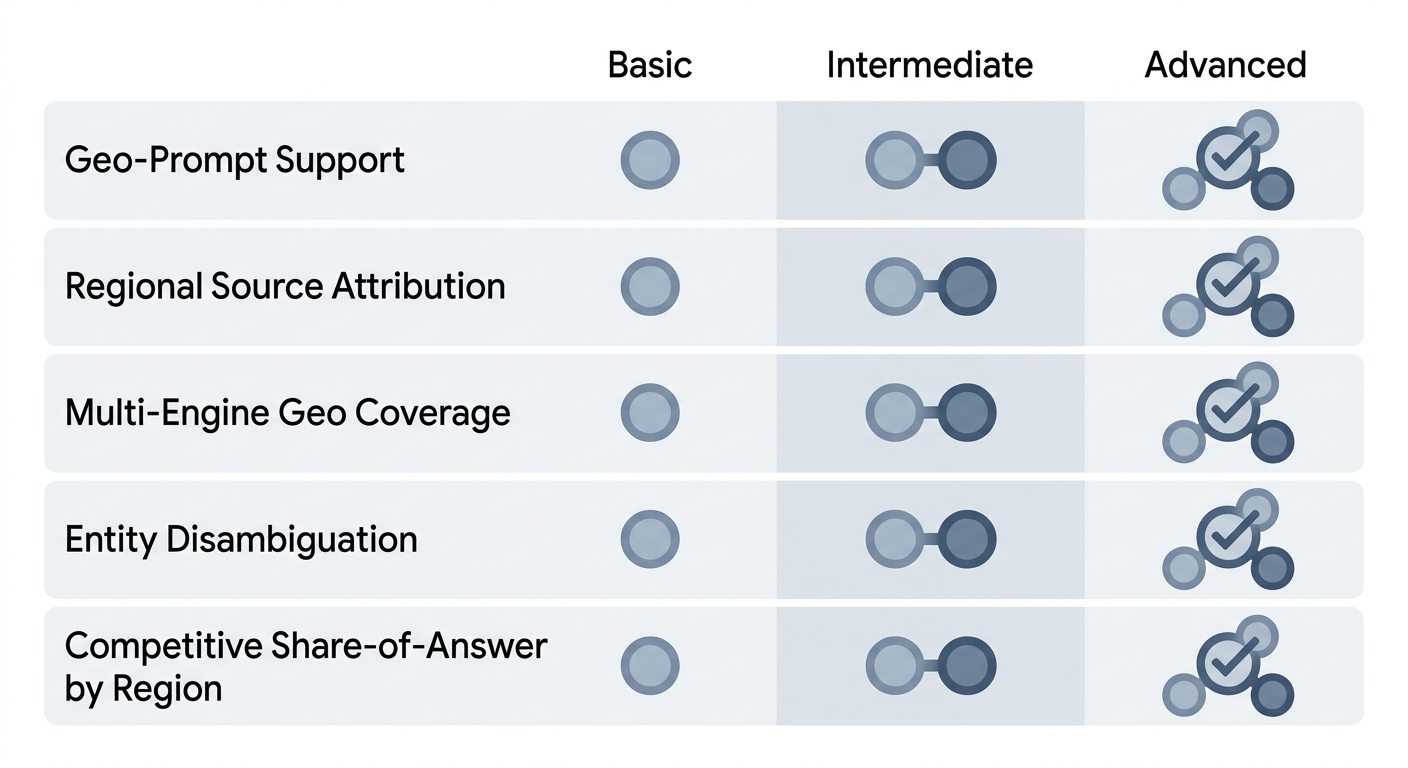
Not every AI visibility tool handles geographic segmentation well. Before committing budget, assess each platform against five criteria specific to geo-targeted monitoring.
Geo-prompt support
Can you run the same prompt with location modifiers (“best X in [city/state/region]”) and track results separately? Tools that treat “best CRM for startups” and “best CRM for startups in Austin” as distinct trackable prompts give you actionable geo data. Tools that only support one global prompt per intent do not.
Regional source attribution
When an AI answer cites a source, does the tool show which publication was referenced? And can you filter citations by publication geography? A brand mentioned because of coverage in a regional trade journal has a different strategic implication than one cited from a national listicle.
Multi-engine coverage with geo consistency
The tool should support at least ChatGPT, Perplexity, and Google AI Overviews — the three platforms where geo signals have the most measurable impact on brand mention variation. Gemini and Claude coverage adds value for enterprise teams. Confirm that geo-filtering works consistently across all supported engines, not just one.
Entity disambiguation at the local level
Brands with common names face amplified false-positive problems in geo tracking. “Summit” could be a consulting firm in Denver, a SaaS platform, or a conference. Tools that support entity rules — confirming mentions through domain, product line, or co-occurring terms — prevent inflated geo dashboards.
Competitive share-of-answer by region
Tracking your own mentions is only half the picture. The tool should let you measure which competitors appear in geo-specific prompts and calculate share of answer per market. This reveals where you’re strong (and where a competitor dominates a region you care about).
Advanced Tools for Geo AI-Generated Brand Mentions: What to Use in 2026
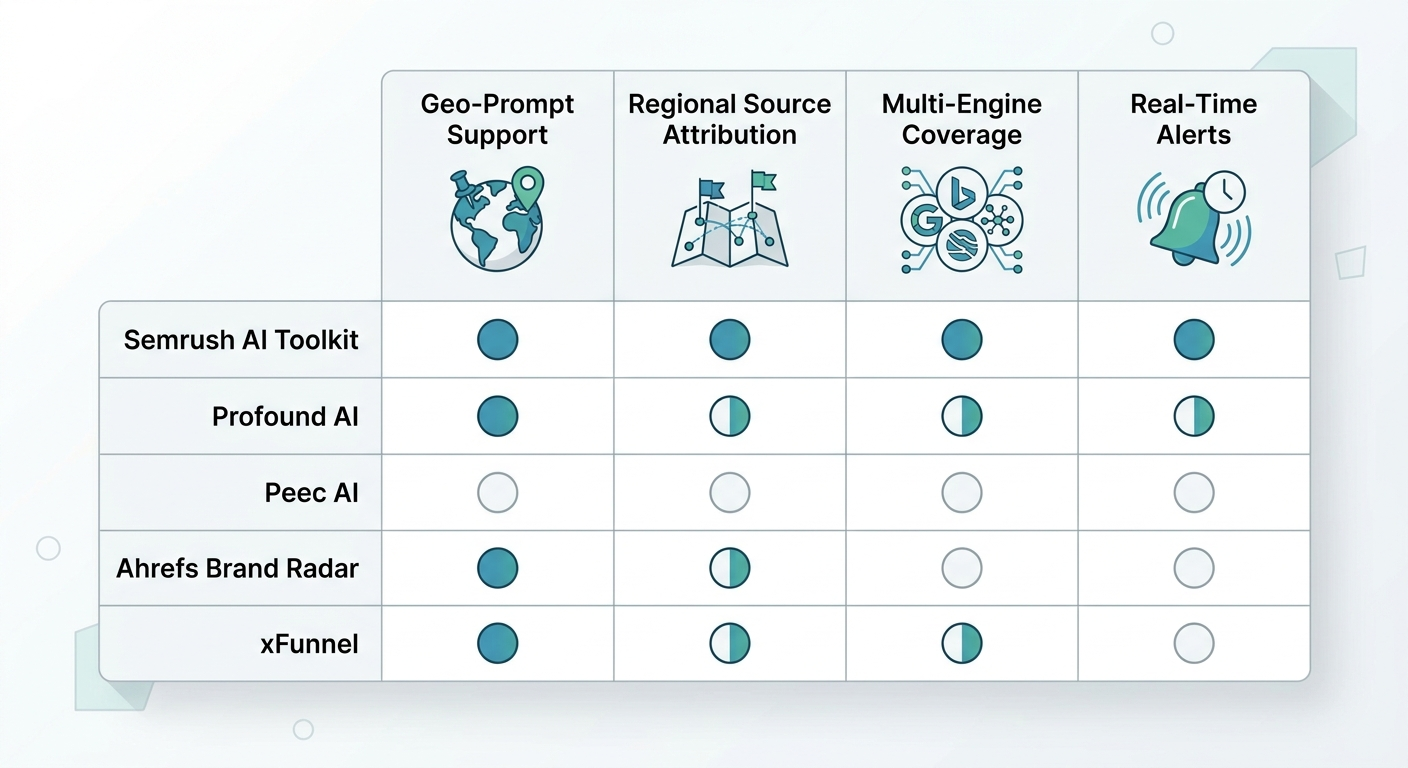
The market now includes both dedicated AI visibility platforms and traditional SEO tools with AI add-ons. Here’s how the most capable options handle geo-specific brand mention tracking, based on publicly available feature sets and pricing as of early 2026.
Semrush AI Visibility Toolkit
Best for: Teams already in the Semrush ecosystem who want geo-layered AI visibility alongside traditional SEO data.
Semrush’s AI Visibility Toolkit generates strategic recommendations based on LLM data, including how AI platforms describe your brand and what shapes public sentiment. As of 2026, the toolkit supports Google AI Overviews and ChatGPT tracking, with Gemini available on higher-tier plans.
For geo tracking, Semrush’s strength lies in connecting AI visibility to its existing location-specific keyword and SERP data. You can compare AI mention patterns for prompts filtered by region, and the competitive benchmarking shows which rivals appear in geo-modified prompts. The strategic recommendation engine — which suggests content, positioning, and product messaging adjustments — factors in regional competitive gaps.
Limitation: Geo-filtering for AI prompts is more developed on Google surfaces than for ChatGPT or Perplexity. Teams needing deep geo coverage across all engines may need to supplement.
Pricing: $99/month per domain for the AI Toolkit add-on; requires a core Semrush subscription starting at $139.95/month.
Profound AI
Best for: Enterprise teams that need to tie geo AI visibility to content performance and source attribution.
Profound positions itself as an enterprise-grade platform for understanding how AI systems evaluate authority and recommend brands. Its Conversation Explorer module tracks real user prompts and shows which pages AI answers reference — a critical feature for geo tracking because you can identify whether your regional content (city-specific landing pages, local case studies) gets pulled into AI responses.
The platform’s agent analytics module shows how AI crawlers interpret your content, which helps diagnose why a brand might appear in AI answers for one region but not another. If your Dallas-focused page isn’t being crawled or understood correctly, Profound surfaces that gap.
Limitation: Higher price point and steeper learning curve. Best suited for teams with dedicated AI visibility resources.
Pricing: Lite starts at $499/month; Growth at $1,499/month; Enterprise custom.
Peec AI
Best for: Marketing teams that want structured prompt organization and real-time alerts with geo segmentation.
Peec AI’s core strength is prompt library management with a marketing-friendly UI. For geo tracking, you can build prompt clusters organized by region — grouping “best [category] in [city]” variants together and monitoring share-of-answer per market.
The real-time alert system is particularly useful for geo monitoring: if your brand suddenly gains or loses visibility in a specific regional prompt cluster, you’ll know immediately rather than discovering it in a weekly report. Source attribution helps identify which regional publications drive AI mentions.
Limitation: Less depth on content performance tracking compared to Profound. Better for monitoring and alerting than for diagnosing why AI models favor certain sources in specific regions.
Pricing: Starting at approximately €89/month (~$104 USD) for 25 prompts; scales to €499/month for 300+ prompts.
Ahrefs Brand Radar
Best for: PR-driven brands that need to connect backlink authority with geo-specific AI mention frequency.
Ahrefs Brand Radar integrates AI mention tracking with Ahrefs’ backlink and domain authority data. The unique advantage for geo tracking is the ability to see whether your authority in a specific region (measured by links from regional publications, local directories, and geo-relevant domains) correlates with higher AI mention rates for that market.
Topic association analysis shows which regional concepts AI connects with your brand — useful for identifying whether your brand is associated with “enterprise security in the Southeast” or “startup tools in the Bay Area.”
Limitation: Still in beta-to-early-access for some AI features. Geo filtering depends on query phrasing rather than native geo segmentation.
Pricing: $199/month for single AI platform; $699/month for all platforms. Requires core Ahrefs subscription starting at $129/month.
xFunnel
Best for: Teams that want to test how geographic messaging variations affect AI brand mentions.
xFunnel’s narrative experimentation capabilities let you test whether changing your regional positioning — adjusting how you describe your market focus on location-specific pages — changes how AI answers frame your brand. The regional perception insights module tracks brand framing differences across U.S. regions and countries.
Persona-based visibility analysis adds another geo-relevant layer: you can see how AI presents your brand to a “VP of Marketing at a mid-market company in the Midwest” versus a “startup founder in New York.”
Limitation: Custom pricing makes budget planning harder for smaller teams. Experimentation features require more hands-on management than passive monitoring tools.
Pricing: Free one-time audit available; paid plans use custom pricing.
Building a Geo-Specific Prompt Library That Produces Reliable Data
The quality of your geo AI visibility data depends entirely on your prompt library. A poorly constructed set will generate noise. A well-structured one reveals actionable gaps.
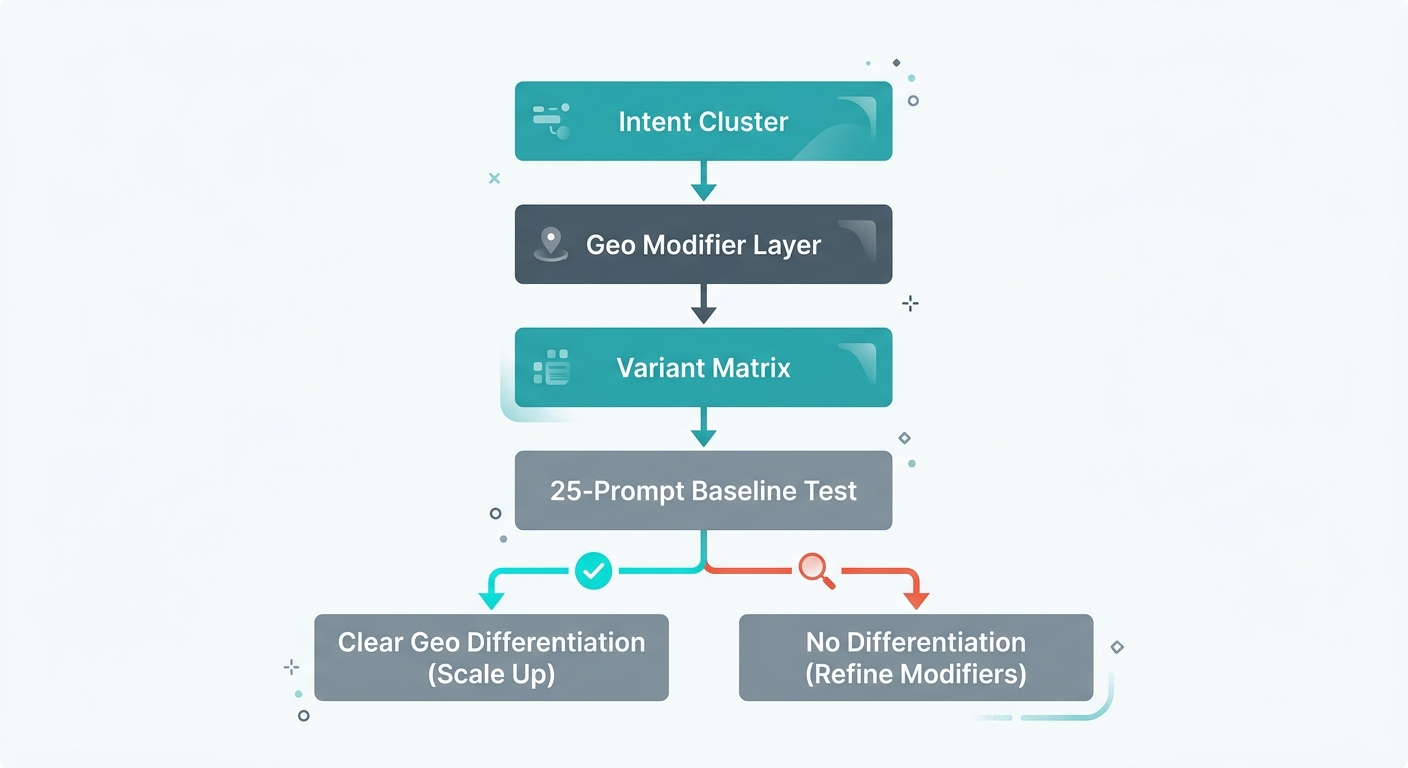
Start with intent clusters, then add geo modifiers
Build your base prompts around buyer intent — the questions your target customers ask when evaluating solutions. Then layer geographic context on top.
Base intent prompt: “Best project management software for remote teams”
Geo variants:
- “Best project management software for remote teams in Texas”
- “Top project management tools for companies in the Northeast”
- “Project management platforms popular with Chicago startups”
Track the base prompt and each variant separately. The delta between them is your geo visibility gap — the difference between how AI models view your brand globally versus in specific markets.
Use three types of geo modifiers
Different geographic signals trigger different AI behaviors:
- City-level: “in Austin,” “in Miami,” “near Denver” — best for local service queries
- State/region-level: “in California,” “in the Southeast,” “for East Coast companies” — best for B2B brands with regional focus
- Implicit geo: “for healthcare companies in compliance-heavy states,” “for financial services firms” — triggers geo-relevant sources without naming a location directly
Implicit geo modifiers are underused but powerful. AI models often infer geography from industry context (healthcare compliance → states with strict regulations; fintech → New York, San Francisco).
Validate with the 25-prompt baseline test
Before scaling to hundreds of prompts, run a focused validation:
- Select 5 core intent prompts
- Create 5 geo variants for each (25 total prompts)
- Run across your primary AI engines
- Record: brand mentioned (yes/no), context (recommended/neutral/negative), source cited, competitor presence
- Calculate share-of-answer per geo cluster
If the data produces a clear, differentiated picture across regions, your prompt structure works. If every region looks the same, your geo modifiers may not be granular enough — or AI models may not yet differentiate your brand geographically (which is itself a strategic finding).
For a deeper walkthrough on tracking brand mentions across AI search platforms, see the full process breakdown.
Reducing False Positives in Geo AI Mention Tracking
False positives are the biggest threat to trustworthy geo AI data. They’re worse in geo-segmented tracking because location modifiers introduce additional ambiguity — a brand name might collide with a city feature, a local business, or a regional term.
Apply entity disambiguation rules per region
Define your brand’s entity fingerprint for each market:
- Brand name + domain: The mention must co-occur with your canonical domain or a known product name
- Category anchor: The mention should appear in context with your product category (“B2B marketing platform,” “cybersecurity solution”)
- Regional anchor: For geo-specific validation, the mention should reference your actual market presence — not just appear alongside a city name coincidentally
A mention only counts as “true” if at least one entity anchor is confirmed in the response context.
Separate prompted recall from organic visibility
If your prompt includes your brand name (“Is BrandX good for companies in Dallas?”), any resulting mention is prompted recall, not organic visibility. Track these separately. The prompts that matter most for competitive intelligence are the ones where your brand name isn’t in the query — “best [category] in [region]” without naming any specific brand.
Tag mention quality, not just mention presence
For every validated mention, apply a three-field tag:
- Presence: Mentioned / Not mentioned
- Attribution: Your domain cited / Third-party cited / No citation
- Intent framing: Recommended / Neutral / Negative
A brand mentioned negatively in Houston prompts and positively in Seattle prompts requires a completely different response than one that’s absent from both. The tag system makes this visible.
For more on how to set up reliable LLM monitoring workflows, see monitoring brand mentions in LLMs.
How Regional Editorial Placements Strengthen Geo AI Visibility
Tracking is only half the equation. Once you know where your brand is missing from geo-specific AI answers, you need to fix those gaps. The most effective lever — and the one most tools don’t provide — is strategic placement of brand mentions on publications that AI models associate with specific regions.
Why regional publications matter for AI training data
AI models build brand-category-geography associations from the content they ingest during training and real-time retrieval. A brand mentioned in a TechCrunch feature gets broad national visibility. The same brand mentioned in the Austin Business Journal, a Texas-focused SaaS review site, and a regional healthcare publication builds a geo-specific entity signal that AI models weight differently for location-modified queries.
In campaigns across 67+ B2B companies, the BrandMentions team found that brands with consistent editorial mentions on regional high-authority publications saw AI recommendation rates improve significantly faster in those specific markets compared to brands relying only on national coverage.
Matching placements to geo visibility gaps
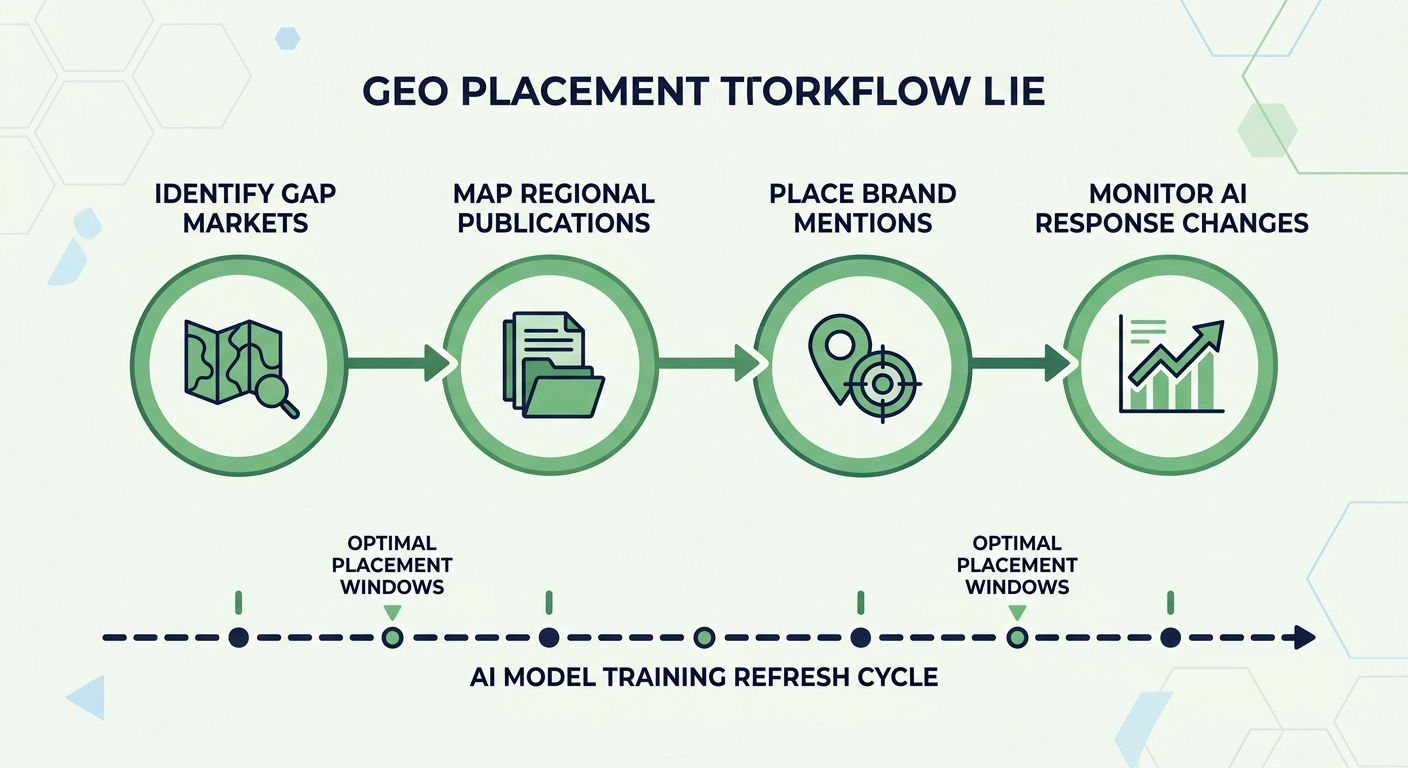
The workflow connects tracking data to placement strategy:
- Identify gap markets: Regions where your share-of-answer is low and competitors dominate
- Map regional publication opportunities: Industry publications, business journals, and editorial sites with strong readership in those markets
- Place contextual brand mentions: Ensure your brand appears naturally in content that AI models will retrieve for geo-specific queries
- Monitor post-placement: Track whether AI mentions in the target region increase after new editorial coverage publishes and gets indexed
This is where the distinction between monitoring tools and placement services matters. Tools like Semrush or Peec AI tell you where you’re invisible. Strategic placement services — like those offered through BrandMentions’ citation network — create the editorial signals that change what AI models say.
Timing placements to AI training cycles
AI models don’t update continuously. Each major model has knowledge refresh cycles — periods when new web content gets incorporated into training data or retrieval indexes. Placing brand mentions shortly before these refresh windows increases the likelihood of inclusion.
As of 2026, ChatGPT’s browsing mode retrieves in near real time, but its base knowledge has specific cutoff dates. Perplexity retrieves live web results for every query. Google AI Overviews draw from Google’s continuously updated index. Each platform’s update cadence affects when your geo placements start influencing AI responses.
For brands in specific verticals, SaaS-specific AI visibility strategies and fintech AI mention approaches require tailored placement targeting that accounts for both vertical and geographic signals.
Measuring Geo AI Visibility: Metrics That Matter
Once your tools and prompt library are running, report on metrics that connect to business outcomes — not vanity counts.
Share-of-answer by region
The percentage of geo-specific prompts where your brand is mentioned. Calculate separately for each market. A brand with 40% share-of-answer in the Bay Area but 8% in the Southeast has a clear strategic priority.
Recommendation rate by region
Of the prompts where your brand appears, how often is it framed as a recommended option versus merely listed? A brand “mentioned” in 30% of Dallas prompts but “recommended” in only 5% has a positioning problem, not a visibility problem.
Citation source distribution
Which publications get cited when AI mentions your brand in a specific region? If your national blog post drives all citations but regional publications drive zero, your geo authority signals are weak. Shift placement efforts toward regional sources.
Competitor displacement tracking
Track prompts where a competitor appears and you don’t — segmented by geography. These “displacement prompts” are your highest-priority content and placement opportunities. If a competitor owns “best compliance software in the Northeast” across every AI engine, that’s the gap to close first.
For a framework on how to interpret and act on these metrics across platforms, see how to track brand mentions in AI search results.
A Practical Geo AI Visibility Stack for 2026
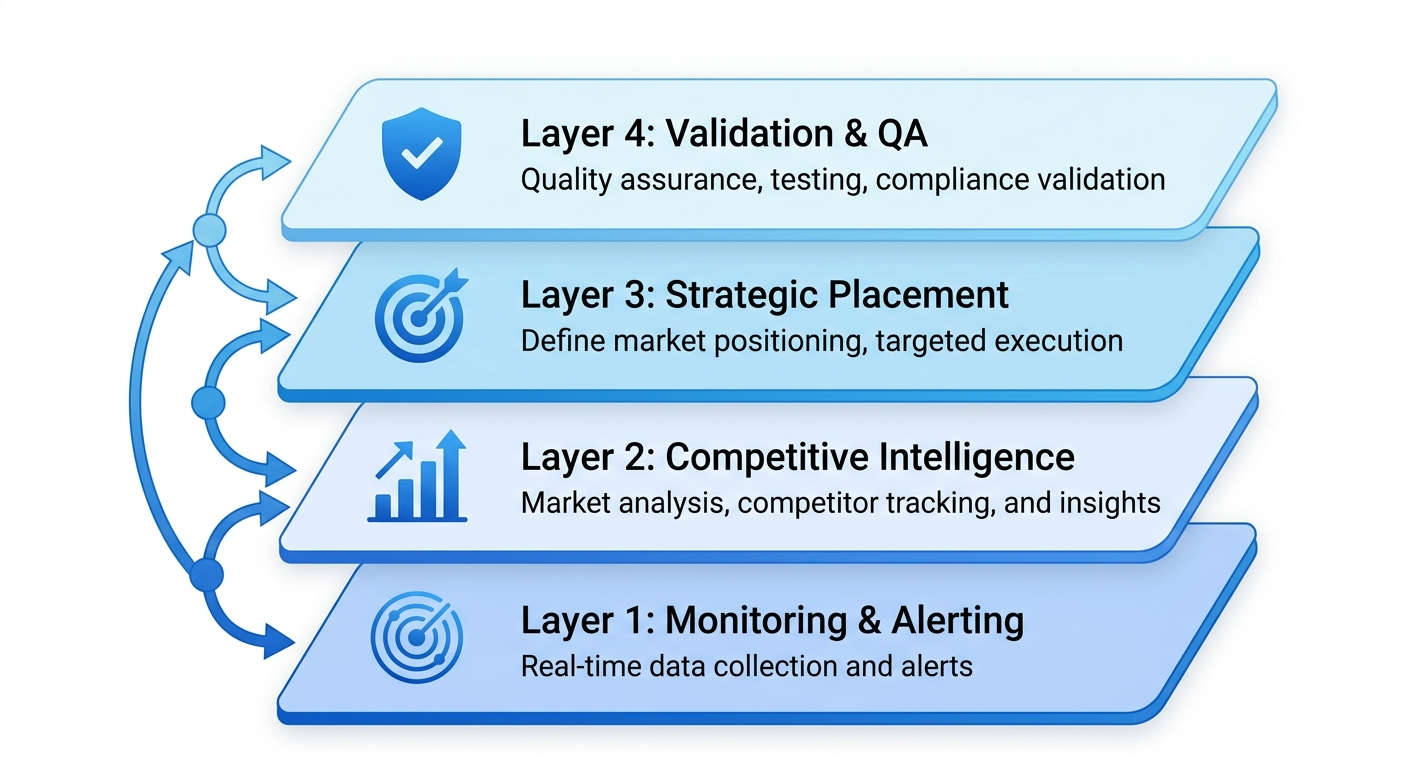
No single tool handles every aspect of geo AI brand mention tracking. The most effective stacks combine monitoring, analysis, and action layers.
Layer 1: Monitoring and alerting
Choose one primary AI visibility tracker with geo-prompt support. Peec AI or Semrush AI Toolkit work well for marketing teams. Profound fits enterprise requirements. Set up geo-segmented prompt clusters with weekly monitoring cadence and real-time alerts for significant changes.
Layer 2: Competitive intelligence
Layer competitive share-of-answer analysis on top of your monitoring data. Most tools listed above support competitor tracking. Ensure you’re measuring regional competitive position — not just global. xFunnel’s persona-based analysis adds depth here.
Layer 3: Strategic placement
Connect visibility gaps to editorial action. When monitoring reveals a region where your brand is absent from AI answers, deploy targeted placements on publications with geo-relevant authority. This is where AI brand mention services create the most measurable impact — turning tracking insights into entity signals that AI models learn from.
Layer 4: Validation and QA
Run monthly reliability checks on your geo data. Sample 20–30 geo-specific prompt results, validate entity matches, confirm context quality, and update your disambiguation rules. Geo tracking is noisier than global tracking — ongoing QA prevents dashboard drift.
What to Expect: Realistic Timelines for Geo AI Visibility Improvement
Geo AI visibility doesn’t shift overnight. Based on campaign patterns through early 2026, here’s what realistic timelines look like:
- Week 1–2: Initial geo prompt library built, baseline data collected, competitive gaps identified
- Month 1–2: First targeted editorial placements published in gap regions; monitoring tracks indexing
- Month 2–4: AI models begin incorporating new regional content into retrieval results; early share-of-answer improvements appear in real-time retrieval engines (Perplexity, ChatGPT browsing)
- Month 4–6: Compounding effect as multiple regional placements build geo-specific entity authority; measurable improvement in recommendation rate and citation source distribution
Teams expecting immediate results will be disappointed. Teams that build consistent, region-specific editorial presence and measure progress monthly will see compounding returns — similar to how traditional SEO authority builds over time, but across a different set of surfaces.
For brands exploring predictive AI alerts for brand mentions, pairing alerting tools with geo-segmented tracking shortens response times when regional visibility shifts.
Frequently Asked Questions
Do AI search engines actually return different brand recommendations based on location?
Yes. Google AI Overviews use searcher location signals to filter and weight sources. ChatGPT’s browsing mode retrieves web results influenced by geographic context. Perplexity pulls from location-relevant sources when queries include geographic modifiers. The variation is measurable — a brand prominent in AI answers for “best CRM in San Francisco” may be absent from the same query targeting “best CRM in Atlanta.” Tracking both is essential for multi-market brands.
How many geo-specific prompts should I track to start?
Begin with 25–50 geo-modified prompts covering 5 core intents across 5 priority markets. This produces enough data to identify patterns without overwhelming your validation process. Scale to 100–200 prompts once you’ve confirmed your entity disambiguation rules reduce false positives to acceptable levels. Quality of prompt design matters more than raw volume.
Can I use free tools to track geo AI brand mentions?
Some platforms offer free tiers or one-time audits — Akii provides free credits, and xFunnel offers a free AI search audit. These work for initial baselines but typically lack the geo-filtering depth, ongoing monitoring, and competitive benchmarking needed for sustained geo visibility programs. Expect to invest $99–$500/month for tools that support serious geo-segmented tracking.
What’s the difference between geo AI tracking and local SEO?
Local SEO optimizes for traditional search results — Google Maps, local pack, organic rankings filtered by location. Geo AI tracking measures whether AI-generated answers mention and recommend your brand when queries have geographic context. The signals overlap (local directories and regional publications influence both), but the measurement, optimization, and surfaces are different. In 2026, strong brands invest in both.
How do I improve AI visibility in a specific city or region?
Start by identifying what AI models currently say about your category in that region using geo-modified prompts. Then build regional entity authority through editorial placements on publications with strong local relevance, city-specific landing pages optimized for AI extraction, and mentions in regional directories and review sites. Brand mentions in generative AI are shaped by the sources AI models retrieve — making the regional source mix the primary lever.
Moving Forward With Geo AI Visibility
Geo-targeted AI brand mention tracking is no longer optional for brands competing across multiple U.S. markets. The tools exist. The measurement frameworks are maturing. And the brands that build geo-specific editorial presence now will compound their advantage as AI search adoption accelerates through 2026 and beyond.
Your next step: audit where your brand appears — and where it doesn’t — across your priority regions. Use the prompt library framework above, pick a tool that fits your budget and team size, and connect monitoring gaps to strategic action.
If you want to see exactly how AI models describe your brand across different markets, request a free AI visibility audit and get a clear picture of your geo-specific competitive position.
Researched and drafted with AI assistance, reviewed and edited by the BrandMentions editorial team.