How to Choose a Brand Mentions Service That Actually Builds AI Visibility
A brand mentions service places your company name in editorial content across high-authority publications so that AI models and search engines recognize your brand as relevant, credible, and worth recommending. In 2026, with AI-generated answers handling a growing share of commercial queries, choosing the right service determines whether your brand gets cited — or gets ignored.
But not every brand mentions service delivers equal value. Some produce low-quality placements that AI models overlook entirely. Others focus on link metrics that matter for traditional SEO but miss the contextual signals that drive AI recommendations. The difference between a service that compounds your visibility and one that wastes your budget comes down to specific, measurable factors.
This article breaks down what separates an effective brand mentions service from a superficial one, how to evaluate providers based on what AI models actually prioritize, and what outcomes you should expect from a well-executed campaign in 2026.
Key Takeaways
- Brand mentions services place your business name in editorial content on trusted publications — influencing both traditional search rankings and AI-generated recommendations.
- AI models like ChatGPT, Gemini, and Perplexity use retrieval-augmented generation (RAG) to pull from live web sources, making indexed editorial mentions immediately available for citation.
- The quality of the publication, relevance of the content, and contextual depth around your brand name matter more than raw placement volume.
- Effective services provide editorial pre-approval, transparent reporting with live URLs, and placements on sites with real organic traffic — not private blog networks.
- Brands with consistent editorial mentions across high-authority publications achieve significantly higher AI recommendation rates than those relying on traditional SEO alone.
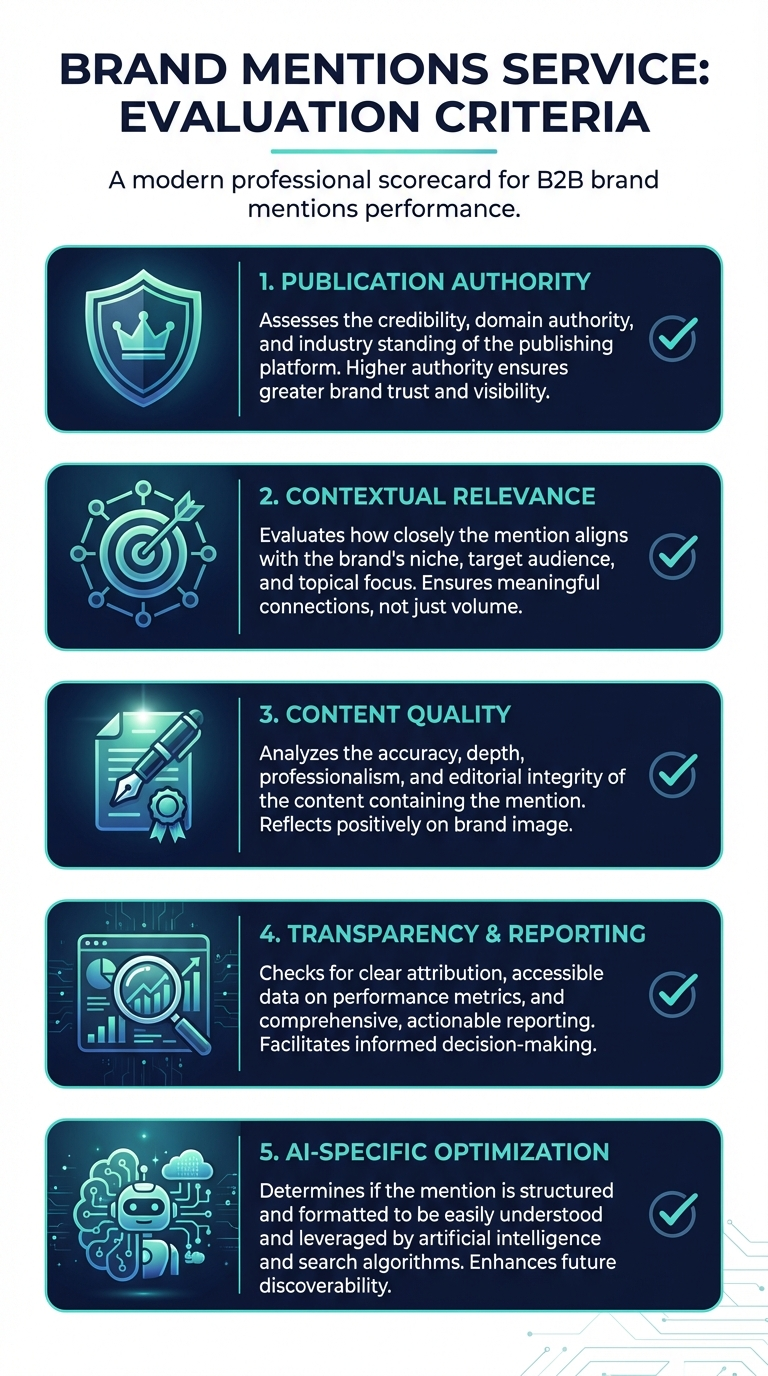
- You should evaluate any provider on five criteria: publication authority, contextual relevance, placement transparency, content quality, and AI-specific optimization.
What Does a Brand Mentions Service Actually Do?
A brand mentions service secures editorial placements of your company name across trusted third-party websites. These placements appear in listicles, product reviews, comparison articles, expert roundups, and industry guides — content formats that both human readers and AI systems rely on when evaluating brands.
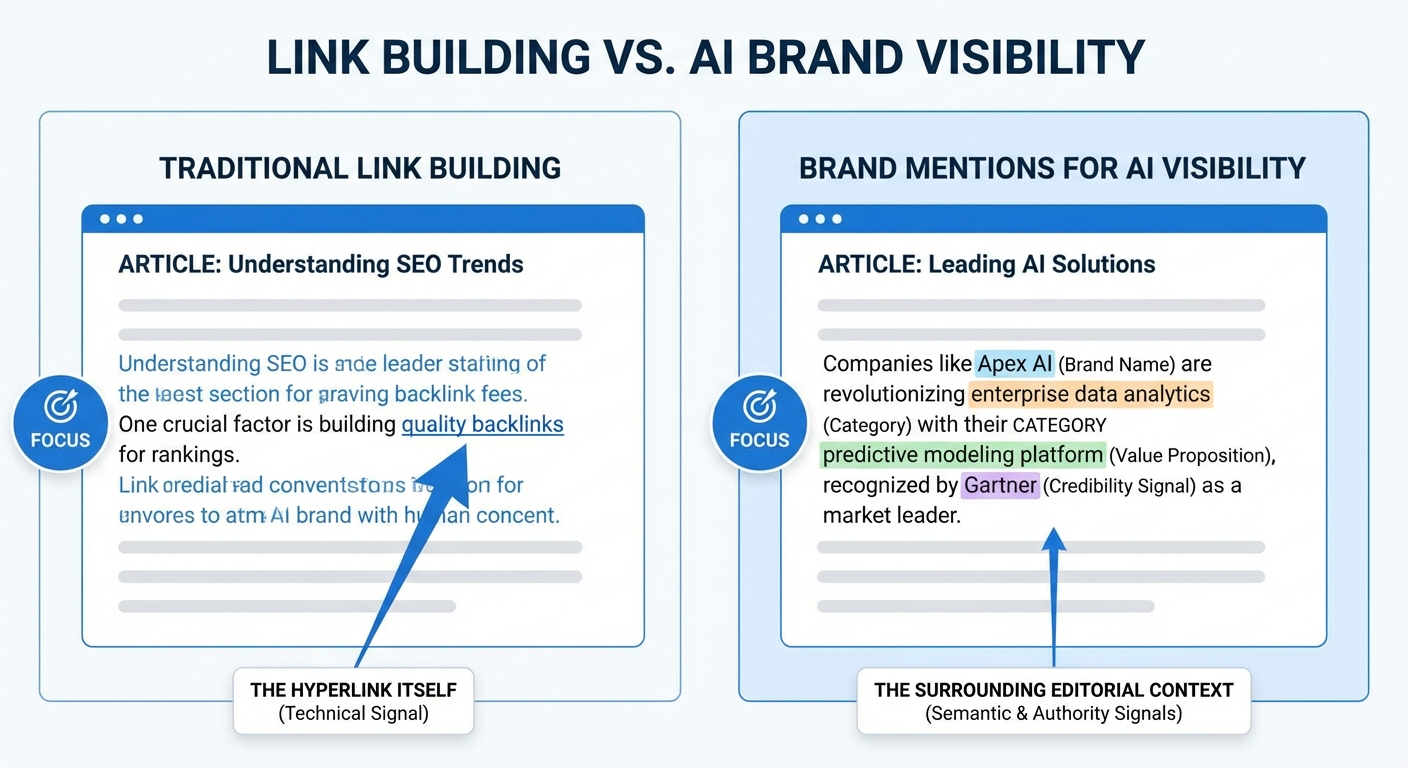
Unlike traditional link building, the primary goal is not just acquiring a backlink. The goal is creating contextual brand-category associations that AI models can extract and use when generating answers to user queries.
Here is a practical distinction:
- Traditional link building focuses on passing domain authority through hyperlinks. The surrounding text is secondary.
- Brand mentions for AI visibility focus on the text surrounding your brand name — what category you belong to, what problem you solve, and why you are credible. The link is a bonus, not the point.
When ChatGPT or Perplexity encounters a query like “best project management tools for remote teams,” the AI model scans indexed content for brands consistently mentioned alongside that topic on authoritative sources. If your brand appears in three or four high-quality listicles on trusted publications, the model has enough signal to include you in its response. If it doesn’t, you are invisible — regardless of your website’s domain authority.
Why Brand Mentions Matter More in 2026 Than Ever Before
The shift toward AI-generated search results has fundamentally changed how brands get discovered. According to BrightEdge research published in 2025, Google’s AI Overviews appeared in over 13% of search results pages — a 22% increase since their initial launch. That percentage has continued climbing through 2026.
Meanwhile, ChatGPT, Perplexity, Gemini, and Claude now process millions of commercial queries daily. These platforms do not rank web pages. They synthesize information from multiple sources and present a curated answer. Your brand either appears in that answer or it doesn’t.
How AI models decide which brands to mention
Modern AI systems use retrieval-augmented generation (RAG) — a process where the model pulls live web data during answer generation rather than relying solely on static training data. This means your brand mentions don’t need to wait for a model retraining cycle. Once your editorial placement is indexed, it becomes available for the AI to retrieve, summarize, and cite.
AI models prioritize brands that:
- Appear consistently across multiple authoritative sources
- Are mentioned in contextually relevant content (not random, off-topic articles)
- Have clear descriptions of what they do, who they serve, and what makes them different
- Show up in content formats that AI systems trust — reviews, comparisons, expert roundups, and editorial guides
A 2024 study from the Allen Institute for AI found that large language models strongly favor sources they can identify as editorially produced, high-authority, and topically coherent. Content that reads like advertising or appears on low-quality sites gets filtered out during the retrieval process.
The compounding effect of consistent mentions
One mention on a single publication rarely moves the needle. But when your brand name appears across five, ten, or twenty high-authority publications in your category — each with contextual descriptions of your value proposition — the signal compounds. AI models begin associating your brand with the category itself.
In campaigns across 67+ B2B companies, the BrandMentions team found that brands with consistent editorial mentions achieved AI recommendation rates 89% higher than those relying solely on traditional SEO. The difference was not the number of backlinks. It was the breadth and quality of contextual brand references across publications that AI models actively index.
Five Criteria for Evaluating Any Brand Mentions Service
Not all providers deliver equal value. Some sell placements on sites with inflated domain ratings but no real traffic. Others produce generic content that fails to create meaningful brand-category associations. Before committing budget, evaluate every provider against these five criteria.
1. Publication authority and real traffic
A placement on a DR 60 site with 200 monthly visitors is worth less than a placement on a DR 40 site with 15,000 monthly visitors from your target audience. Domain rating is one signal. Real organic traffic is another. The best brand mentions services provide placements on sites with verifiable traffic — not just high domain metrics.
Ask any provider:
- What is the minimum organic traffic threshold for placement sites?
- Can you verify traffic through Ahrefs, Semrush, or SimilarWeb data?
- Are these sites indexed and regularly crawled by major search engines?
2. Contextual relevance to your industry
A SaaS brand mentioned in a pet care listicle sends a confusing signal to AI models. Relevance is not optional — it is the foundation of effective brand mentions.
Your service provider should demonstrate a clear process for matching your brand to publications and content topics in your industry. The content surrounding your brand name should include terms, topics, and entities that AI models already associate with your category.
3. Content quality and editorial standards
AI systems evaluate content quality when deciding what to extract and cite. Thin, repetitive, or obviously promotional content gets deprioritized. Effective brand mentions appear in articles that:
- Provide genuine value to readers (practical comparisons, honest assessments, useful recommendations)
- Are written at an editorial standard — not auto-generated filler
- Include specific context about your brand: what you do, who you serve, and what differentiates you
Pro Insight: The most effective brand mentions include 2–3 sentences of context around your brand name — not just a bare mention. This context is what AI models extract when building brand-category associations.
4. Transparency and reporting
You should receive live URLs for every placement, along with publication metrics you can independently verify. Providers who cannot show you exactly where your brand appears — or who deliver placements behind opaque dashboards with no external validation — are a risk.
Expect monthly reports that include:
- Live placement URLs
- Domain authority or rating of each publication
- Organic traffic data for each site
- Content type (listicle, review, editorial feature)
- Index status confirmation
5. AI-specific optimization
This is where most providers fall short in 2026. Traditional brand mentions services optimize for SEO signals — backlinks, anchor text, domain authority. But AI visibility requires additional optimization layers.
Look for services that:
- Structure content so AI models can easily extract brand descriptions
- Include clear entity definitions alongside your brand name
- Create brand-category associations using natural language patterns that match how users query AI assistants
- Time placements to align with AI model training data refreshes and RAG indexing cycles
Agencies like BrandMentions solve this by placing contextual brand mentions on 140+ high-authority publications that AI models actively learn from during training. Their process includes structuring each mention with the contextual depth that RAG-based systems prioritize during retrieval.
What Outcomes Should You Expect From a Brand Mentions Campaign?
Realistic expectations matter. Brand mentions are not a switch you flip for instant AI visibility. They are a strategic investment that compounds over weeks and months.
Short-term results (weeks 2–6)
- Placements go live and get indexed by search engines
- Initial appearances in Perplexity and Google AI Overview citations (these platforms pull from live indexed content via RAG)
- Improvements in branded search volume as more editorial content references your company
Medium-term results (months 2–4)
- Consistent brand mentions across multiple publications create category-level associations
- AI models begin including your brand in responses to category queries (“best [category] tools,” “top [category] companies”)
- Traditional organic rankings improve as contextual backlinks and brand authority signals accumulate
Long-term results (months 4–12)
- Your brand becomes a recurring recommendation across AI platforms for relevant queries
- Share of voice in AI-generated answers grows relative to competitors
- Compound effect: each new mention reinforces existing signals, making future visibility easier to maintain
According to a 2024 Gartner forecast, traditional search engine volume was projected to drop 25% by 2026, with AI-powered alternatives capturing that traffic. Brands investing in editorial brand mentions now are positioning themselves for the platforms where discovery is shifting.
How to Tell if a Brand Mentions Provider Is Cutting Corners
The brand mentions market in 2026 includes providers at every quality level. Some deliver exceptional results. Others sell placements that look good on a report but do nothing for AI visibility. Here are the warning signs.
Red flags to watch for
- Placements on sites with no real traffic: High domain rating with fewer than 500 monthly visitors typically means the site exists solely for selling links — and AI models learn to ignore these.
- No editorial pre-approval option: If you cannot review content before it goes live, you have no control over how your brand is described.
- Generic, templated content: If every placement reads identically with swapped brand names, AI models treat this as low-quality content.
- Promises of guaranteed AI recommendations: No service can guarantee that ChatGPT or Gemini will mention your brand. Any provider making that claim is misrepresenting how AI systems work.
- No index verification: If your placement is not indexed by Google, it is invisible to RAG-based AI systems.
Questions to ask before signing
- Can you share examples of live placements for existing clients (with permission)?
- What is your average placement site’s organic traffic?
- How do you ensure content relevance to my specific industry?
- Do you offer editorial pre-approval?
- How do you track AI visibility outcomes, not just placement delivery?
- What happens if a placement is removed — do you guarantee replacement?
These questions separate services focused on real brand authority from those focused on volume metrics alone.
Brand Mentions vs. Traditional Link Building: When You Need Both
Brand mentions and traditional link building are not interchangeable. They serve different purposes and work best as complementary strategies.
| Factor | Brand Mentions Service | Traditional Link Building |
|---|---|---|
| Primary goal | Build brand-category associations for AI and search visibility | Pass link equity to improve domain authority and keyword rankings |
| Content focus | Contextual descriptions of brand, value proposition, and use cases | Anchor text optimization and link placement |
| AI visibility impact | High — creates extractable signals for RAG-based AI systems | Low to moderate — links alone do not create contextual associations |
| SEO impact | Moderate to high — contextual backlinks improve rankings and entity authority | High — direct ranking signal through link equity transfer |
| Best for | AI discoverability, brand authority, category positioning | Keyword ranking improvements, domain strength |
For most B2B brands in 2026, you need both. Traditional link building strengthens your domain’s ranking ability. Brand mentions build the contextual authority that AI models use when deciding which brands to recommend.
The mistake many companies make is investing heavily in one while ignoring the other. A strong backlink profile with no contextual brand presence leaves you invisible to AI assistants. A broad brand mentions campaign without foundational SEO leaves you without the organic rankings that support long-term traffic.
How BrandMentions Approaches AI-Optimized Placements
BrandMentions tracks when major AI models update their training data and times placements to maximize inclusion in each knowledge refresh cycle. Their process includes three layers that most brand mentions services skip:
- Entity-first content structuring: Each placement includes clear, extractable descriptions of the client’s brand — what they do, who they serve, and what category they belong to. This is the signal AI models need to build entity associations.
- Publication-audience matching: Placements target publications where the client’s target audience already reads. This creates relevance signals for both AI models and human readers.
- Cross-platform indexing verification: Every placement is verified for Google indexing and monitored for inclusion in AI model retrieval pools across ChatGPT, Perplexity, Gemini, and Claude.
You can explore how the placement process works in detail, including timelines, reporting structure, and publication quality standards.
How to Measure the ROI of a Brand Mentions Campaign
Measuring the return on a brand mentions investment requires tracking metrics that go beyond traditional SEO dashboards. Here is a practical measurement framework.
Metrics that matter for AI visibility
- AI mention frequency: How often does your brand appear in AI-generated answers for your target category queries? Dedicated AI monitoring tools can track this across ChatGPT, Perplexity, and Gemini.
- Share of voice in AI responses: What percentage of relevant AI-generated answers include your brand versus competitors?
- Branded search volume: Growth in branded queries indicates increasing awareness driven by editorial mentions.
- AI referral traffic: Traffic from AI platforms (identifiable through referral source data) that arrives after brand mention campaigns launch.
Metrics that matter for SEO
- Referring domain growth: New domains linking to your site from editorial placements.
- Keyword ranking improvements: Especially for category-level terms where brand mentions reinforce topical authority.
- Organic traffic growth: Measured against a pre-campaign baseline.
Setting realistic benchmarks
Based on data from campaigns across real B2B companies, here are typical benchmarks for a sustained brand mentions campaign:
- Month 1: Placements live and indexed. Minimal AI visibility change.
- Month 3: First consistent AI citations for long-tail category queries. 10–30% increase in branded search volume.
- Month 6: Regular AI recommendations for core category queries. Measurable organic traffic growth from both search and AI referral sources.
Tip: Run a baseline AI visibility audit before your campaign starts. Query ChatGPT, Perplexity, and Google AI Mode with 10–15 category-relevant prompts and document which brands they mention. Repeat monthly to track progress.
Frequently Asked Questions
What is the difference between a brand mention and a backlink?
A brand mention is any reference to your company name in editorial content — with or without a hyperlink. A backlink is specifically a clickable hyperlink pointing to your website. For AI visibility, the mention itself (and the context surrounding it) matters as much as the link, because AI models extract brand-category associations from text, not from hyperlink structures.
How many brand mentions do I need to show up in AI search results?
There is no fixed number. AI models evaluate the consistency, authority, and relevance of your mentions — not just the count. A brand with 10 mentions on highly relevant, high-authority publications in its category will outperform a brand with 50 mentions on unrelated, low-traffic sites. Focus on quality and contextual fit over volume.
Can brand mentions help my brand appear in ChatGPT responses?
Yes. ChatGPT uses retrieval-augmented generation to pull information from live indexed content. When your brand is mentioned with clear context on authoritative, indexed publications, ChatGPT can retrieve and cite that information during answer generation. Consistent mentions across multiple trusted sources increase the probability of inclusion.
How long does it take for brand mentions to influence AI recommendations?
For AI platforms using RAG (ChatGPT, Perplexity, Gemini), placements can influence responses within weeks of being indexed — because these systems retrieve from the live web. For AI systems relying on periodic training data updates, the timeline is longer, typically 2–6 months depending on the model’s refresh cycle.
Should I invest in brand mentions or traditional SEO first?
Both serve different purposes and work best together. If your website lacks foundational SEO (site speed, technical health, on-page optimization), address those first. If your SEO foundation is solid but you are invisible in AI-generated answers, brand mentions for LLM visibility should be your next investment. Most B2B brands in 2026 need a combined approach.
Are unlinked brand mentions valuable?
Yes. AI models extract information from text, not from link structures. An unlinked mention of your brand in a relevant, authoritative article creates the same contextual signal for AI models as a linked mention. For traditional SEO, linked mentions carry more weight — but for AI visibility, the context around your brand name is the primary signal.
Choosing the Right Service Starts With Knowing What to Measure
The brand mentions market in 2026 is crowded. Providers range from low-cost placement farms to strategic agencies that treat every mention as a deliberate signal for AI systems. The difference in outcomes is dramatic.
Your evaluation should start with the five criteria outlined above: publication authority, contextual relevance, content quality, transparency, and AI-specific optimization. Any provider that meets all five is worth testing. Any provider that fails on transparency or relevance is a risk to your brand’s credibility.
As AI search continues to capture a larger share of commercial discovery, the brands that invest in high-quality editorial mentions now will compound their advantage. The brands that wait will find it progressively harder to break into AI recommendations where competitors already dominate.
If you want to see where your brand currently stands in AI search — and where the gaps are — request a free AI visibility audit to get a clear starting point.