How to Choose the Best Tool to Track Brand Mentions on ChatGPT in 2026
The best tool to track brand mentions on ChatGPT depends on your team size, budget, and how many AI platforms you need to monitor. Dedicated AI visibility trackers — purpose-built to scan large language model (LLM) responses — outperform manual testing and traditional social listening tools because they automate prompt-level monitoring, store historical data, and benchmark your brand against competitors across ChatGPT, Gemini, Perplexity, and Claude simultaneously.
As of 2026, ChatGPT processes billions of queries daily, according to TechCrunch reporting from mid-2025. Many of those queries are product comparisons, service recommendations, and “best tool for X” questions that directly influence purchasing decisions. If you do not know whether ChatGPT mentions your brand — or misrepresents it — you are flying blind in the fastest-growing discovery channel in B2B and B2C.
This article breaks down every viable approach to ChatGPT mention tracking, compares the leading platforms feature by feature, and walks you through a practical selection framework so you can pick the right tool for your situation — without overpaying or under-monitoring.
Key Takeaways
- Manual prompt testing is free but unreliable at scale — ChatGPT responses vary by session, phrasing, and browsing mode.
- Traditional social listening tools like Brand24 and Mention.com do not monitor AI-generated answers.
- Dedicated AI visibility trackers (Ahrefs Brand Radar, Semrush AI Toolkit, Rankshift, Keyword.com, and others) automate prompt scanning across multiple LLMs.
- The right tool depends on three factors: how many AI platforms you track, how often you need data refreshed, and whether you need competitor benchmarking.
- Server log analysis reveals when ChatGPT’s browsing mode retrieves your pages in real time — a complementary signal most brands overlook.
- AI visibility tracking is not a one-time audit. Model updates, training data refreshes, and shifting citation patterns require ongoing monitoring.
- Brands with consistent editorial mentions on high-authority publications achieve measurably higher AI recommendation rates than those relying on owned content alone.
Why Tracking Brand Mentions on ChatGPT Requires a Different Approach
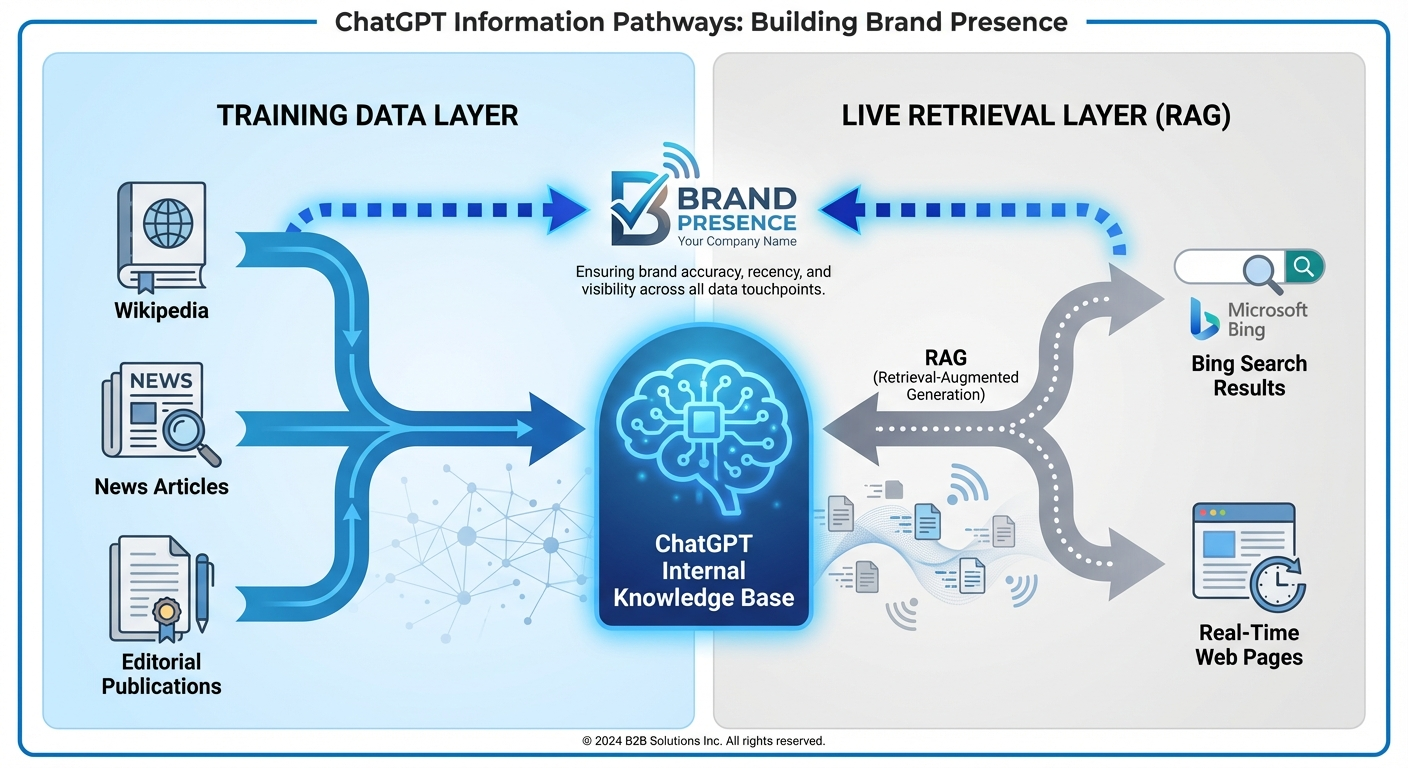
ChatGPT is not a search engine. It does not return a list of ranked links. It synthesizes information from training data and — when browsing is enabled — from live web retrieval, then generates a conversational answer. This fundamental difference breaks every assumption traditional monitoring tools rely on.
A brand mention in ChatGPT is any instance where ChatGPT names your company, product, or domain directly in its generated response. A citation is a clickable source link ChatGPT attaches to support its answer. These are not the same thing, and the distinction matters for strategy.
Research published by Semrush in early 2025 found that roughly 46% of ChatGPT queries trigger live web retrieval, while the remaining 54% are answered purely from the model’s internal training data. This means your brand can appear (or be absent) from two entirely separate information layers — and you need visibility into both.
What traditional tools miss
Google Search Console tells you nothing about ChatGPT. Google Analytics cannot detect AI-referred visits with any reliability. Social listening platforms like Brand24 scan websites, forums, and social posts — not the text inside AI-generated responses.
Even if you rank first on Google for your target keyword, ChatGPT may never mention your brand. LLMs weigh entity recognition, training data frequency, editorial authority, and structured content differently than Google’s ranking algorithm.
That gap is why a new category of AI visibility tracking tools exists in 2026. They solve a problem no prior tool was designed to address.
The Four Methods for Tracking ChatGPT Mentions
Every approach to tracking brand mentions on ChatGPT falls into one of four categories. Each has distinct strengths, costs, and failure modes. Understanding all four helps you build a layered monitoring system — or decide which single method fits your current stage.
Method 1: Manual prompt testing
Open ChatGPT in an incognito browser, log out, and type the questions your customers ask. Record whether your brand appears, how it is described, which competitors are named, and whether citations link to your site.
When to use it: Initial benchmark. Quick spot-checks after a product launch or PR push. Teams with no budget for paid tools.
Critical limitation: ChatGPT responses are non-deterministic. The same prompt can produce different answers across sessions. Without running dozens of variations weekly, your data is anecdotal — not actionable. This method does not scale beyond a handful of prompts.
Tip: Test with ChatGPT’s web search toggled on and off. Responses from training data alone reveal how well-established your brand’s entity associations are. Responses with search enabled show whether your live content earns citations. The difference tells you where to focus improvement efforts.
Method 2: Custom API scripts
Developers can use OpenAI’s API to programmatically send prompts, parse responses for brand names, log results to a database, and run reports over time.
When to use it: Technical teams building proprietary analytics pipelines. Companies that need highly customized prompt sets or integration with internal dashboards.
Critical limitation: You must manage API costs, maintain scripts as model versions change, and build your own reporting interface. Unless your team has dedicated engineering resources, the maintenance overhead often outweighs the flexibility.
Method 3: Server log analysis
When ChatGPT’s browsing mode retrieves your pages, it sends a bot with the user-agent string ChatGPT-User. By filtering your server logs for this string, you can see exactly which pages ChatGPT fetches in real time — and how often.
When to use it: As a complementary signal alongside prompt tracking. Particularly valuable for identifying technical blockers (pages rendered entirely in JavaScript, incorrect status codes, or firewall rules) that prevent ChatGPT from accessing your content.
Critical limitation: Logs only capture retrieval-based interactions. They reveal nothing about answers generated from training data alone — which account for roughly half of all ChatGPT queries, based on the 2025 Semrush click-stream study.
Method 4: Dedicated AI visibility tracking tools
Purpose-built platforms send your prompt sets to ChatGPT (and typically Gemini, Claude, and Perplexity) on automated schedules, detect brand and competitor mentions, score sentiment, track citation sources, and visualize trends over time.
When to use it: Any brand or agency that needs reliable, repeatable AI visibility data across multiple models. This is the primary method for teams treating AI discoverability as a strategic channel.
Critical limitation: Data quality depends on prompt design. If your prompt set does not reflect the actual questions your buyers ask, your visibility scores will be misleading. Budget ranges from approximately $29/month to $500+/month depending on platform and scale.
Comparing the Leading AI Visibility Tracking Tools
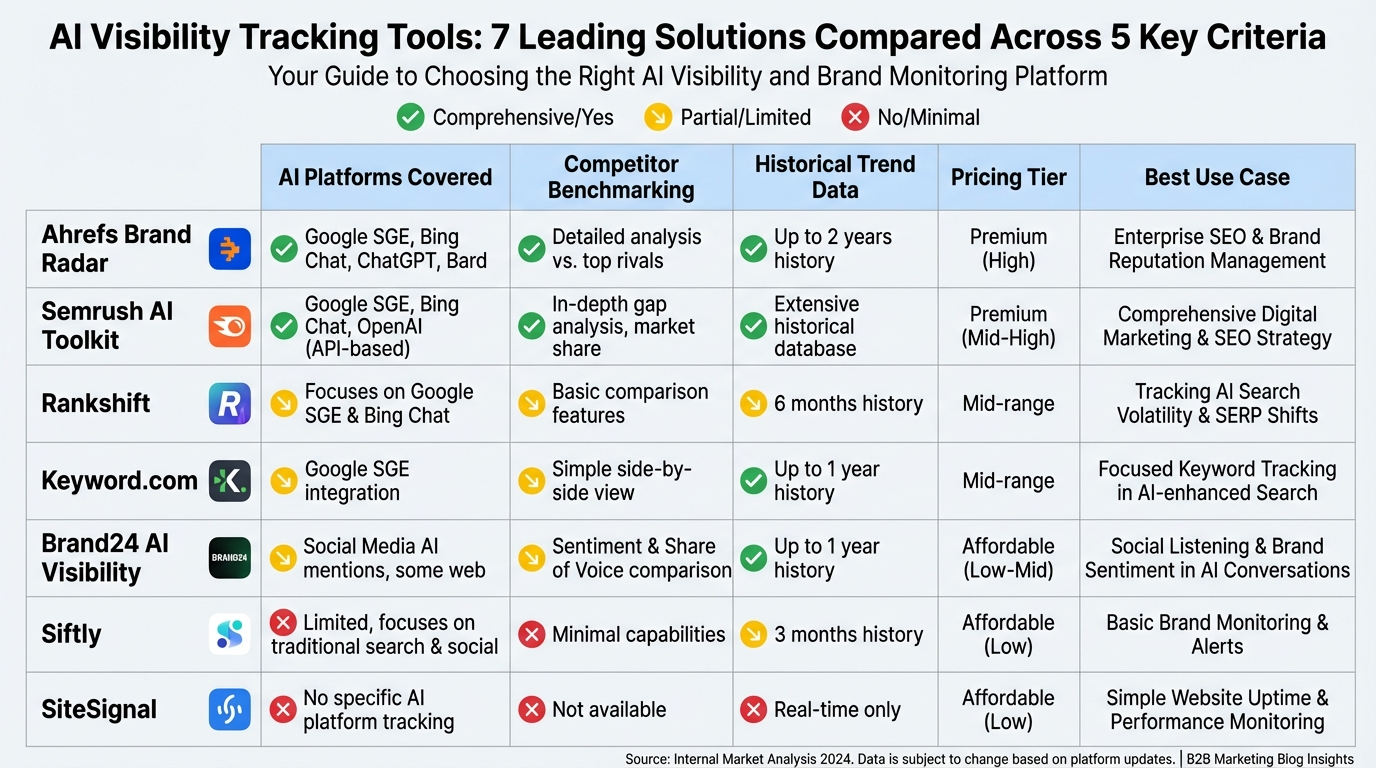
The market for ChatGPT mention tracking tools has matured rapidly since late 2024. The platforms below represent the most widely adopted options as of 2026, each with a different strengths profile. No single tool is universally “best” — the right choice depends on your existing tech stack, monitoring scope, and whether you need AI tracking as a standalone capability or integrated with broader SEO workflows.
Ahrefs Brand Radar
Ahrefs added its Brand Radar feature to track brand mentions across ChatGPT, Gemini, and other AI models. It connects AI visibility data with Ahrefs’ existing backlink and keyword databases, making it a strong choice for teams already using Ahrefs for SEO.
- AI platforms tracked: ChatGPT, Gemini, additional models in the Brand Radar index
- Key strength: Integrates AI mention data with traditional SEO metrics — cited domains, fan-out queries, and competitor share of voice in a unified dashboard
- Custom prompts: Yes — configure specific conversational queries with daily, weekly, or monthly cadence
- Best for: SEO teams that want AI visibility layered into their existing Ahrefs workflow
- Limitation: Requires an Ahrefs subscription, which may be cost-prohibitive for smaller teams focused solely on AI tracking
Semrush AI Visibility Toolkit
Semrush expanded into AI visibility tracking with tools that cover ChatGPT and Google AI Overviews. The platform auto-detects relevant prompts based on your domain, reducing setup time.
- AI platforms tracked: ChatGPT, Google AI Overviews, expanding coverage
- Key strength: Automatic prompt discovery based on your domain and market positioning — useful for teams unsure which queries to monitor
- Pricing: Starting at $99/month as part of broader Semrush plans
- Best for: Marketing teams already invested in Semrush who want AI tracking without adding another vendor
- Limitation: Coverage of non-Google AI platforms is still expanding. Less granular prompt-level control than some dedicated tools.
Rankshift
Rankshift is a dedicated LLM visibility platform with a credit-based system. You allocate credits across any combination of AI models, making it flexible for teams that prioritize different platforms.
- AI platforms tracked: ChatGPT, Gemini, Claude, Perplexity, Google AI Overviews
- Key strength: Credit-based flexibility — allocate monitoring resources to the models that matter most for your audience
- Unique feature: Server log analysis tool that identifies AI bot crawling behavior on your site
- Best for: Brands and agencies that need multi-model coverage with customizable frequency
- Limitation: Credit system requires planning; heavy monitoring across all platforms can exhaust credits quickly on lower-tier plans
Keyword.com AI Rank Tracker
Keyword.com positions its AI rank tracker as a natural extension of traditional keyword tracking. It monitors brand inclusion, sentiment, and competitor mentions inside ChatGPT responses specifically.
- AI platforms tracked: ChatGPT (OpenAI GPT), with expanding model support
- Key strength: Familiar rank-tracking interface adapted for AI visibility — low learning curve for SEO professionals
- Unique feature: AI Visibility Score that quantifies your brand’s presence relative to competitors for each tracked prompt
- Best for: SEO agencies and in-house teams that want ChatGPT tracking integrated with existing rank tracking workflows
- Limitation: Strongest for ChatGPT specifically; cross-platform coverage across Gemini, Claude, and Perplexity is less mature than some competitors
Brand24 AI Brand Visibility Tool
Brand24 — traditionally a social listening platform — launched an AI Brand Visibility module that tracks mentions across seven AI models including ChatGPT, Gemini, Claude, and Perplexity, according to Brand24’s product documentation as of early 2026.
- AI platforms tracked: ChatGPT, Gemini, Claude, Perplexity, and three additional models
- Key strength: Combines social web monitoring with AI visibility tracking in one subscription — helpful for PR teams managing both channels
- Unique feature: Brand Score metric and median position tracking across AI responses
- Best for: Teams that need social listening and AI mention tracking without managing two separate platforms
- Limitation: AI tracking is an add-on to a social listening tool — may lack the prompt-level depth of purpose-built AI trackers
Other notable platforms
Several additional tools have entered this space:
- Siftly: Focused on Generative Engine Optimization with cross-platform tracking and competitive intelligence. Reports starting around $249/month.
- SiteSignal: Combines AI mention monitoring with website health auditing. Designed for agencies managing multiple client brands.
- Peec.ai and Otterly AI: Lighter-weight trackers focused on prompt-level ChatGPT monitoring.
- Geneo and Promptwatch: Emerging tools focused on prompt analytics and mention frequency scoring.
Feature-by-Feature Comparison Table
| Platform | AI Models Covered | Competitor Tracking | Historical Trends | Starting Price | Best For |
|---|---|---|---|---|---|
| Ahrefs Brand Radar | ChatGPT, Gemini, expanding | Yes | Yes | Included in Ahrefs plans | SEO teams on Ahrefs |
| Semrush AI Toolkit | ChatGPT, AI Overviews | Yes | Yes | ~$99/month | Semrush users expanding to AI |
| Rankshift | ChatGPT, Gemini, Claude, Perplexity, AI Overviews | Yes | Yes | ~€77/month | Multi-model flexibility |
| Keyword.com | ChatGPT (primary) | Yes | Yes | Free trial available | ChatGPT-focused rank tracking |
| Brand24 AI Visibility | 7 models (ChatGPT, Gemini, Claude, Perplexity, +3) | Yes | Yes | Custom pricing | PR + AI tracking combo |
| Siftly | ChatGPT, Gemini, Perplexity, AI Overviews | Yes | Yes | ~$249/month | Dedicated GEO strategy |
| SiteSignal | ChatGPT, Gemini, Claude, Perplexity | Yes | Yes | Paid (varies) | Agencies + site health |
How to Choose the Right Tool for Your Situation
Selecting the best tool to track brand mentions on ChatGPT is not about finding the “best” platform in absolute terms. It is about matching a tool’s strengths to your specific requirements. Use the decision framework below to narrow your options quickly.
Start with three questions
- How many AI platforms do you need to monitor? If ChatGPT is your only priority, a ChatGPT-focused tool like Keyword.com may be sufficient. If you need cross-platform coverage across Gemini, Claude, and Perplexity, prioritize tools like Rankshift, Brand24, or Siftly that track multiple models natively.
- Do you already use a major SEO platform? If your team runs on Ahrefs, Brand Radar adds AI tracking without a new vendor. If you use Semrush, its AI Toolkit integrates naturally. Adding a standalone AI tracker on top of an existing SEO suite creates tool sprawl — sometimes justified, often not.
- What is your monitoring cadence? Weekly spot-checks require less tool sophistication than daily automated monitoring with alert triggers. If you need real-time awareness of visibility changes — for example, after a competitor’s product launch or a model update — look for tools with automated scheduling and alert functionality.
Decision paths by team type
Solo founder or early-stage startup: Start with manual prompt testing to establish a baseline. Supplement with a free trial from Keyword.com or Rankshift. You do not need enterprise-grade monitoring until you have enough brand presence to track meaningfully.
In-house marketing team (Series A–C SaaS): Choose a tool that integrates with your existing SEO stack. Ahrefs Brand Radar or Semrush AI Toolkit avoids adding another login. If AI visibility is a top-three priority, consider a dedicated platform like Rankshift or Siftly for deeper prompt-level data.
Agency managing multiple clients: Prioritize multi-project support, white-label reporting, and cross-platform coverage. Rankshift’s credit system scales across client accounts. SiteSignal combines AI tracking with site health monitoring — useful for agencies offering full-stack SEO and AI visibility services.
Enterprise marketing team: Layer multiple methods. Use your SEO platform’s AI module for trend-level data, add server log analysis for retrieval-layer visibility, and supplement with a dedicated tracker for prompt-level granularity. At enterprise scale, no single tool covers every angle.
What These Tools Cannot Tell You — and What to Do About It
Every AI visibility tool has a structural limitation: they measure what ChatGPT says in response to prompts you define. They cannot monitor the millions of unique, unpredictable prompts real users type every day.
This means your visibility data is only as good as your prompt library. A poorly designed prompt set produces misleading scores. Here is how to build a prompt set that reflects actual buyer behavior:
- Category queries: “Best [your product category] for [specific use case]” — these are high-intent prompts where purchase decisions happen.
- Comparison queries: “[Your brand] vs [competitor]” — track whether ChatGPT positions you favorably, unfavorably, or ignores you.
- Problem-solution queries: “How do I [solve a problem your product addresses]?” — reveals whether ChatGPT associates your brand with the problem you solve.
- Reputation queries: “What do people think about [your brand]?” — surfaces sentiment and accuracy issues.
- Decision-stage queries: “Is [your brand] worth it?” or “Should I use [your brand] for [use case]?” — critical for bottom-of-funnel influence.
Aim for 15–25 core prompts with 3–5 phrasing variations each. This reduces wording bias and accounts for ChatGPT’s non-deterministic responses. Update your prompt set quarterly as your product evolves and new competitors emerge.
Beyond Tracking: How to Improve What ChatGPT Says About Your Brand
Monitoring alone does not change outcomes. If your tracking reveals that ChatGPT ignores your brand — or describes it inaccurately — the fix involves strengthening your brand’s presence in the information sources LLMs rely on.
Build entity authority through editorial mentions
ChatGPT’s training data comes from web crawls of high-authority publications, industry sites, and editorial content. The more consistently your brand appears in these contexts — associated with your core product category — the stronger the entity association the model learns.
This is where strategic brand mentions on high-authority publications compound over time. A single mention matters less than a pattern of authoritative editorial references that reinforce your brand-category connection.
In campaigns across 67+ B2B companies, the BrandMentions team found that brands with consistent editorial mentions across high-authority publications achieved AI recommendation rates significantly higher than those relying solely on owned content and traditional SEO.
Structure your content for AI extraction
ChatGPT’s browsing mode retrieves pages and extracts information in real time. Content structured with clear headings, direct Q&A formatting, and concise definitions makes extraction easier. Key practices:
- Lead each section with a direct answer to the question the heading poses.
- Use schema markup (FAQ, Product, HowTo) so retrieval systems can parse your content accurately.
- Serve critical pages as static HTML — AI bots do not execute JavaScript.
- Keep product information, pricing, and feature descriptions current. Outdated content causes inaccurate AI responses.
Earn citations from sources ChatGPT trusts
According to a 2025 analysis by Ahrefs, 67% of ChatGPT’s top 1,000 cited domains are sources that marketers cannot directly control — Wikipedia, Reddit, government sites, and major publications. The remaining 33% represents your opportunity: industry blogs, review platforms, comparison sites, and editorial publications where you can build a presence through PR, guest contributions, and strategic partnerships.
Focus your outreach on the publications that AI models actively learn from during training data updates. Agencies like BrandMentions track when major AI models update their training data and time placements to maximize inclusion in each knowledge refresh cycle.
Monitor and correct inaccuracies
If ChatGPT describes your product incorrectly — wrong pricing, discontinued features, outdated positioning — the fix is publishing updated, explicit content that contradicts the outdated information. LLMs prioritize clear, specific, recent statements over ambiguous older content.
Create a dedicated page on your site that states exactly what your product does, who it serves, and what it costs — in plain language. Update it every quarter. This gives ChatGPT’s retrieval system a reliable, authoritative source to pull from.
A Practical Monitoring Workflow for 2026
Combining multiple methods produces the most complete picture of your AI visibility. Here is a workflow you can implement this week:
- Week 1 — Baseline audit: Run 20–30 manual prompts in ChatGPT (incognito, logged out, browsing on and off). Document mentions, competitor appearances, and accuracy issues in a spreadsheet.
- Week 2 — Tool selection: Based on the decision framework above, activate a free trial of the tool that best fits your stack. Import your prompt set and configure competitor tracking.
- Week 3 — Log analysis setup: If you have server access, filter logs for the ChatGPT-User user-agent string. Identify which pages ChatGPT fetches and which are blocked by JavaScript rendering or firewall rules.
- Ongoing — Weekly review: Check your AI visibility dashboard weekly. Compare mention rates, sentiment shifts, and competitor movements. Flag inaccuracies for immediate content correction.
- Monthly — Prompt set update: Add new prompts based on product changes, new competitors, or emerging customer questions. Remove prompts that are no longer relevant.
- Quarterly — Strategy adjustment: Review trends across three months. Identify which content and citation efforts correlated with visibility improvements. Double down on what works.
Pro Insight: AI models update their training data and citation behavior on different schedules. A visibility gain in ChatGPT may not appear in Gemini or Claude simultaneously. Track each model independently to understand where your brand stands across the full AI ecosystem.
What Has Changed Since 2024–2025
The AI visibility tracking landscape has shifted substantially in the past 18 months. If your last evaluation of these tools happened in 2024, the market looks different now:
- Major SEO platforms entered the space. Ahrefs and Semrush both launched native AI visibility modules in late 2024 and early 2025. Before that, only standalone tools existed. This mainstreamed AI mention tracking as a standard marketing capability.
- ChatGPT’s browsing mode became more frequent. The June 2025 ChatGPT Search update increased the percentage of queries that trigger live retrieval, making real-time content freshness more important for citation earning.
- Model-specific behaviors diverged. ChatGPT, Gemini, Claude, and Perplexity each handle citations differently. A 2025 study found ChatGPT includes citation links in roughly 20% of mentions, while Perplexity averages over 5 citations per answer but mentions brands less frequently. Multi-model tracking became essential, not optional.
- Google AI Overviews expanded. BrightEdge reported in 2025 that AI Overviews appeared in over 11% of search queries with a 22% increase since launch. Tracking your visibility in AI Overviews alongside ChatGPT is now a baseline expectation.
These shifts mean any tool recommendation from 2024 is potentially outdated. Evaluate platforms based on their 2026 feature set — not historical reviews.
Frequently Asked Questions
Can I track brand mentions on ChatGPT for free?
Yes, through manual prompt testing. Open ChatGPT in incognito mode, ask questions your customers would ask, and document the results. This method is free but not scalable. Responses change between sessions, so manual checks produce snapshots rather than reliable trend data. For ongoing monitoring, a dedicated tracking tool is necessary.
Do social listening tools like Brand24 track ChatGPT mentions?
Brand24 added a dedicated AI Brand Visibility module that tracks mentions across seven AI models including ChatGPT. However, its traditional social listening features do not cover AI-generated responses. Other social listening tools like Mention.com do not monitor AI assistant answers at all. Verify that any tool you evaluate specifically tracks LLM-generated responses, not just web and social mentions.
How often should I check my brand’s AI visibility?
Weekly monitoring catches meaningful shifts in visibility, especially after model updates or competitor content changes. For brands actively investing in AI visibility campaigns, daily automated tracking with alert triggers provides the fastest feedback loop. Monthly is the minimum cadence for brands at earlier stages.
What if ChatGPT never mentions my brand?
This typically indicates weak entity authority — your brand is not represented frequently or prominently enough in the sources ChatGPT learns from. The solution involves building consistent editorial mentions on high-authority publications, structuring your owned content for AI extraction, and earning citations from the domains ChatGPT trusts most. An AI visibility audit can identify the specific gaps in your brand’s information footprint.
Does ranking first on Google mean ChatGPT will mention my brand?
Not necessarily. ChatGPT draws from training data and Bing-indexed content for its browsing mode — not Google rankings directly. A brand can rank first on Google and still be absent from ChatGPT responses if it lacks presence in the editorial and reference sources that feed LLM training data. SEO and AI visibility are related but distinct channels.
How do I know if my tracking prompt set is good enough?
A strong prompt set covers five intent layers: category queries, comparison queries, problem-solution queries, reputation queries, and decision-stage queries. Include 3–5 phrasing variations per prompt to account for ChatGPT’s non-deterministic behavior. If your visibility scores swing wildly between checks, your prompt set likely needs more variations or broader coverage.
Moving Forward With AI Visibility Tracking
The best tool to track brand mentions on ChatGPT is the one that matches your monitoring scope, integrates with your workflow, and provides actionable data — not just dashboards. For most B2B marketing teams in 2026, that means a dedicated AI visibility tracker layered on top of your existing SEO platform, supplemented with quarterly manual audits and server log analysis.
Tracking is the foundation. What you do with the data — strengthening editorial presence, correcting inaccuracies, building entity authority — is what actually moves your brand from invisible to recommended.
If you want to understand where your brand stands across ChatGPT, Gemini, Perplexity, and Claude today, see where your brand stands in AI search.