
An AI overviews mentions tool tracks whether your brand appears inside Google’s AI-generated search answers — showing you citation URLs, mention frequency, and competitive gaps that traditional rank trackers miss entirely. As of 2026, nearly half of all Google searches trigger an AI Overview, and if your brand isn’t being cited in those summaries, you’re invisible at the exact moment potential customers form buying preferences.
This article breaks down how AI overviews mentions tools actually work, what separates useful tracking from vanity dashboards, and how to turn citation data into content decisions that improve your visibility. Whether you’re evaluating tools for the first time or replacing one that underdelivers, you’ll walk away knowing exactly what to measure and why.
What You’ll Learn
- How AI overviews mentions tools differ from traditional rank trackers — and why that distinction matters for your pipeline
- The specific citation metrics that predict whether your brand will gain or lose AI visibility over time
- Why Google Search Console can’t show you AI Overview performance — and what fills that gap
- How to evaluate whether a tool provides auditable citation evidence or just surface-level scores
- A practical framework for turning tracking data into content actions that earn more citations
- What’s changed in AI Overview tracking since 2024–2025 as Google expanded Overviews globally
Why Traditional Rank Trackers Miss the AI Overviews Picture
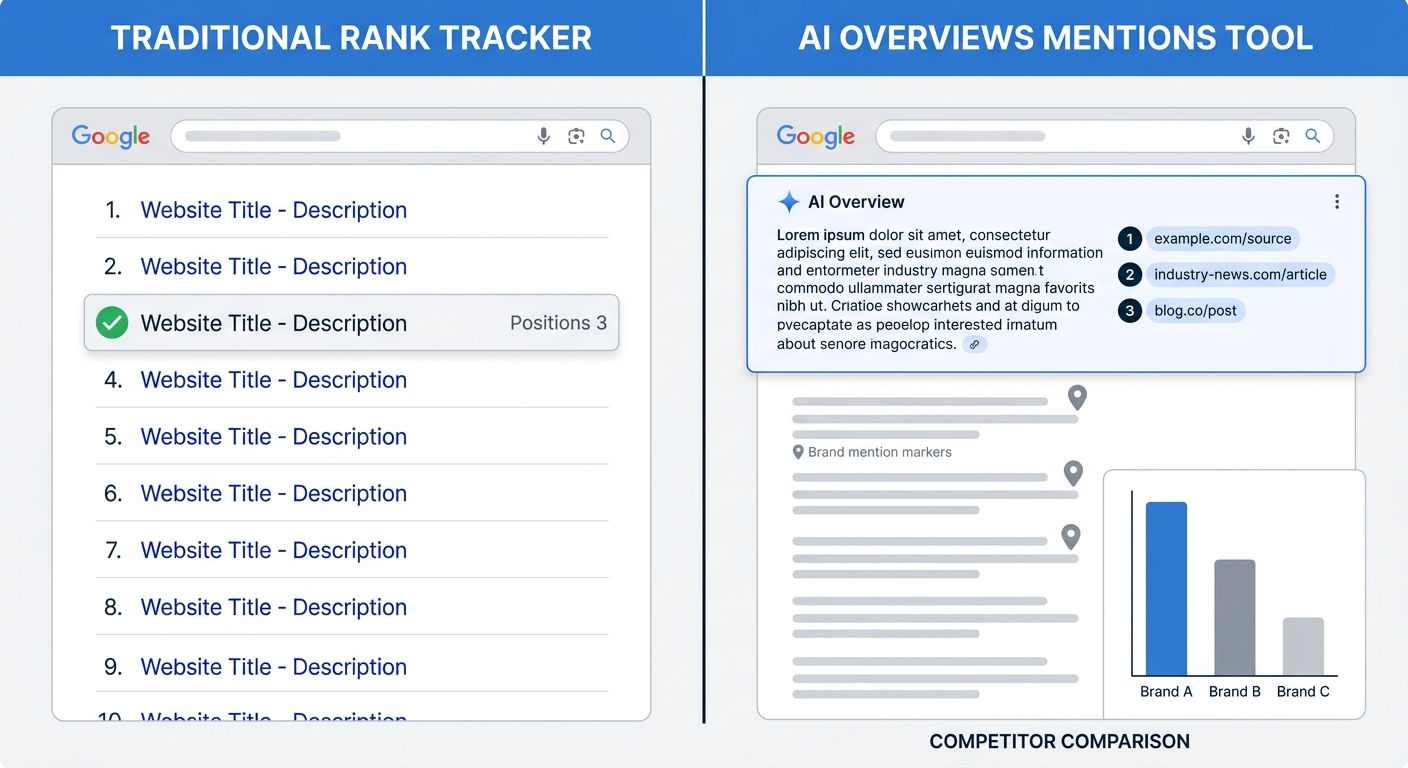
Traditional rank trackers measure where your URL sits among blue links. That metric still matters — but it ignores a fundamental shift in how Google presents answers.
An AI Overview is an AI-generated summary that appears above organic results, synthesizing information from multiple sources and citing them inline. When one appears, it captures user attention before anyone scrolls to position one.
Here’s the problem: your page can rank #1 organically and still be absent from the AI Overview for the same query. According to BrightEdge research published in 2025, AI Overviews appeared on roughly 47% of tracked queries — and the #1 organic result was not always among the cited sources.
Standard rank trackers report your position among traditional results. They don’t tell you:
- Whether an AI Overview exists for your target keyword
- Which URLs Google cited as sources inside that Overview
- Whether your brand was mentioned by name — even without a direct link
- How your citation frequency compares to competitors across AI-generated answers
This is the gap an AI overviews mentions tool fills. It monitors the AI-generated layer of search — the layer that increasingly shapes first impressions and brand consideration.
How an AI Overviews Mentions Tool Actually Works
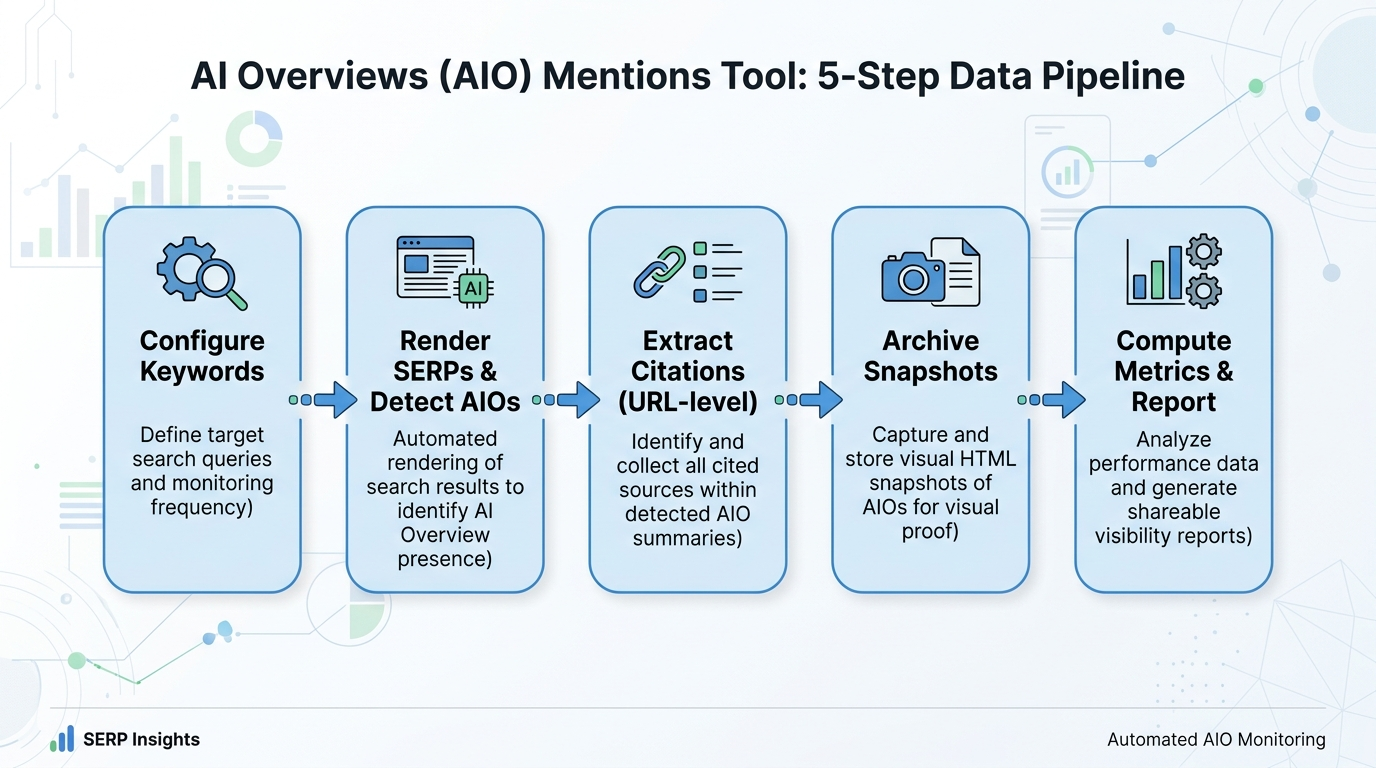
Understanding the mechanics helps you evaluate whether a tool delivers real data or estimated guesses. Most credible platforms follow a similar pipeline:
Step 1: Keyword and Query Configuration
You define the keywords or conversational queries you want to monitor. Some tools let you import keywords from Google Search Console. Others generate query suggestions based on your domain’s content.
The best tools frame queries as natural-language questions — matching how AI Overviews are triggered. Queries like “best CRM for mid-market B2B companies” are more likely to generate an AI Overview than a short keyword like “CRM software.”
Step 2: SERP Rendering and AI Overview Detection
The tool loads Google search results for each query, typically through browser-based execution in specific geographic locations. It then detects whether an AI Overview appeared — because not every query triggers one.
This step matters more than it sounds. A tool that only checks whether your URL ranks organically, without confirming whether an AI Overview was present, gives you incomplete data.
Step 3: Citation Extraction at the URL Level
When an AI Overview is detected, the tool parses which URLs Google embedded as sources. This is the most critical capability separating serious tools from superficial ones.
Credible extraction captures:
- Explicit citations — your domain URL appears as a direct linked source inside the Overview
- Implicit mentions — your brand name appears in the AI-generated text without a direct link
- Competitor citations — which rival domains were cited for the same query
Step 4: Snapshot Archival and Historical Tracking
AI Overviews are volatile. Research from Ahrefs published in 2025 found that AI Overview content changes approximately 70% of the time, and cited sources change about 46% of the time. A single snapshot tells you almost nothing. Historical tracking across weeks and months reveals patterns.
Tools that archive timestamped SERP snapshots — including the full AI Overview text and cited URLs — give you auditable evidence of what Google displayed on a specific date.
Step 5: Metric Computation and Reporting
From the raw data, the tool calculates metrics like citation frequency, share of voice compared to competitors, and trends over time. The output typically feeds into dashboards, CSV exports, or API integrations for custom reporting.
The Metrics That Actually Matter for AI Overview Visibility
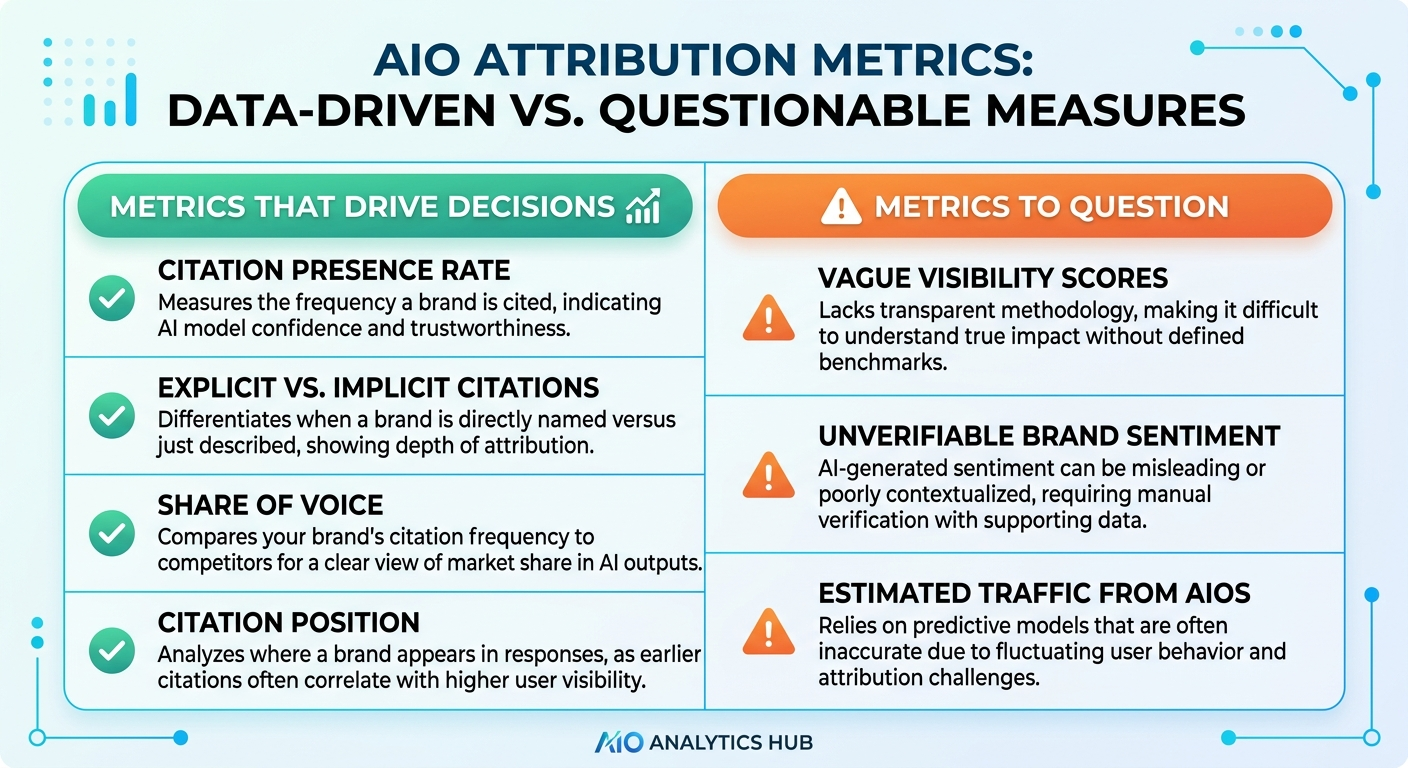
Not all metrics are equally useful. Some tools display impressive-sounding scores that don’t connect to anything actionable. Here’s what to focus on — and what to question.
Citation Presence Rate
This measures what percentage of your tracked queries return an AI Overview where your domain or brand is cited. A presence rate of 30% across 200 tracked queries tells you that you appear in roughly 60 AI Overviews. This is your baseline.
Explicit vs. Implicit Citations
An explicit citation means your URL appears as a clickable source link in the AI Overview. An implicit citation means your brand name is mentioned in the generated text — often pulled from third-party sources that reference you — without a direct link to your domain.
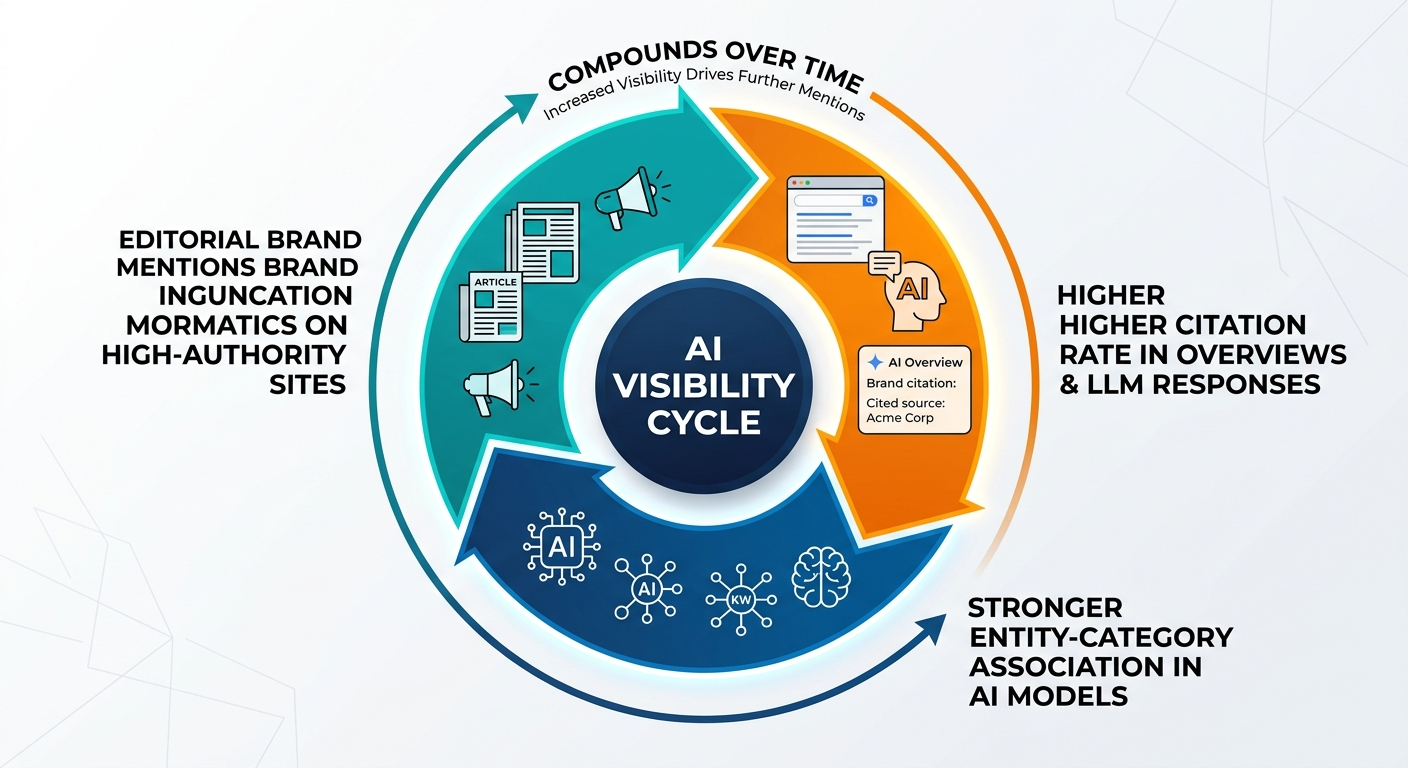
Both matter, but they serve different purposes. Explicit citations can drive referral traffic. Implicit mentions build brand awareness and category association — which compounds over time as AI models reinforce the connection between your brand and specific topics.
Share of Voice Against Competitors
This compares your citation frequency to competitors across the same set of queries. If a competitor appears in 45% of AI Overviews for your tracked keywords and you appear in 18%, the gap is clear — and it tells you where to prioritize content improvements.
Citation Position Within the Overview
Some tools track where your citation appears within the AI Overview — first source, second source, or further down. Earlier positions typically receive more user attention, similar to how higher organic rankings earn more clicks.
Metrics to Question
Be skeptical of any metric that can’t be verified against real SERP data. A “visibility score” of 72 out of 100 means nothing if the tool can’t show you the underlying queries, the actual AI Overview text, and the specific URLs cited. Ask vendors: can I see the raw SERP snapshot that produced this score? If the answer is no, the metric is decorative.
Why Google Search Console Can’t Track AI Overview Mentions
Google Search Console (GSC) remains the primary source of truth for organic search performance. But it has a significant blind spot: it doesn’t separate AI Overview data from standard organic results.
When a user clicks a link inside an AI Overview, that click appears in GSC as a regular organic click. There’s no filter, label, or dimension that identifies it as coming from an AI Overview. The same applies to impressions — GSC doesn’t distinguish between an impression in a blue link and an impression as a cited source inside an AI-generated summary.
This means GSC can’t tell you:
- Which keywords triggered AI Overviews
- Whether your URL was cited in the AI-generated answer
- How your CTR changed specifically because of AI Overview presence
- Which competitors were cited alongside you
The workaround some SEOs use — filtering GSC for informational queries and comparing CTR before and after known AI Overview expansion dates — provides directional estimates. But it’s not the same as knowing which specific queries showed your brand in an AI Overview on a given day.
This is precisely why dedicated AI overviews mentions tools exist. They fill the analytics gap that Google has not addressed as of 2026.
Pro Insight: If you notice CTR dropping on high-ranking informational keywords without losing positions, an AI Overview is likely absorbing clicks. An AI overviews mentions tool confirms whether you’re at least being cited in that Overview — or whether competitors captured that visibility entirely.
What Changed in AI Overview Tracking Since 2024–2025
The AI Overview landscape has shifted rapidly. Understanding what’s different in 2026 helps you evaluate tools based on current capabilities rather than outdated assumptions.
Global Expansion of AI Overviews
In May 2025, Google expanded AI Overviews to over 200 countries and territories and more than 40 languages, according to Google’s official announcements. Before that expansion, most tracking tools focused exclusively on US English queries. As of 2026, multi-market tracking — with geo-specific SERP rendering — is no longer optional for international brands.
Google AI Mode
Google introduced AI Mode as a distinct search experience that goes beyond standard AI Overviews. Some tracking tools now monitor both AI Overviews (which appear within traditional search results) and AI Mode (which offers a fully conversational search interface). If your audience uses AI Mode, a tool that only tracks traditional AI Overviews misses part of the picture.
Increased Volatility in Citations
Early AI Overviews were relatively stable in the sources they cited. As Google has refined its Gemini-based models throughout 2025 and into 2026, citation sources shift more frequently. Tools that check weekly may miss significant changes that happened mid-week. Daily refresh cycles have become the minimum standard for reliable tracking.
Cross-Platform Monitoring as Standard
In 2024, most tools focused solely on Google AI Overviews. By 2026, the market expectation has shifted. Teams now want to track brand mentions across AI search platforms — including ChatGPT, Perplexity, Gemini, and Claude — alongside Google. Many tools have expanded to cover multiple AI engines, recognizing that brand perception is formed across several platforms simultaneously.
How to Evaluate an AI Overviews Mentions Tool
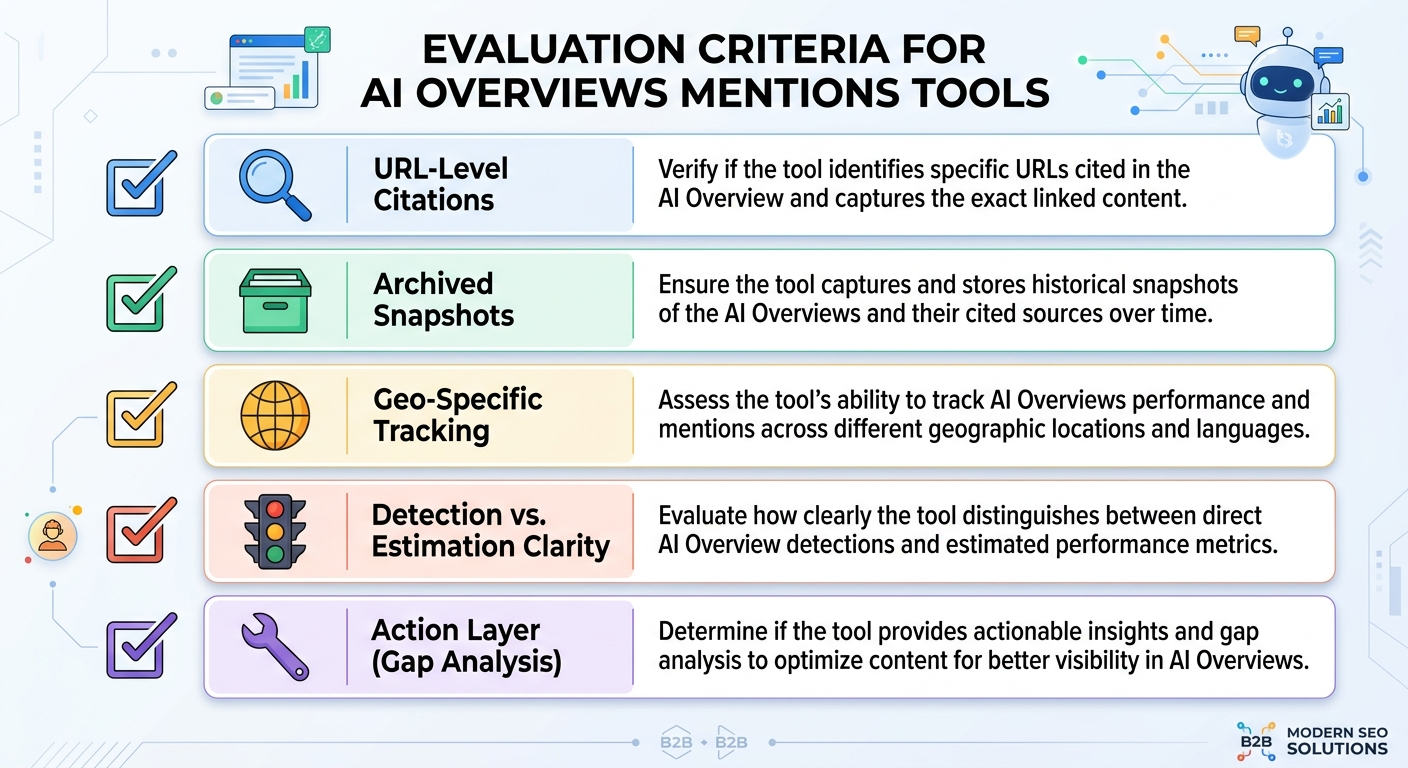
With dozens of platforms claiming to track AI Overviews, the differences between them are often hidden behind similar-sounding marketing. Use these criteria to separate useful tools from noise.
Does It Provide URL-Level Citation Data?
This is non-negotiable. A tool that reports “your brand was mentioned in 40% of AI Overviews” without showing the exact URLs cited — for both your domain and competitors — is hiding the most actionable information. URL-level data lets you reverse-engineer what content Google trusts enough to cite.
Does It Archive SERP Snapshots?
AI Overviews are dynamic. If a tool only shows you today’s results without historical snapshots, you can’t diagnose why citations appeared or disappeared. Archived snapshots — with timestamps, query parameters, and the full AI Overview text — are essential for debugging and reporting.
Does It Support Geo-Specific Tracking?
AI Overview content varies by country and language. A tool that only renders SERPs from a single US location may show you citations that don’t exist for your UK, German, or Australian audience. Multi-country support with actual browser-based rendering in each location provides accurate, localized data.
Does It Distinguish Detection from Traffic Estimation?
Some tools attempt to estimate traffic from AI Overviews. Be cautious with these numbers. Since Google doesn’t separate AI Overview clicks from organic clicks in any analytics platform, any traffic estimate is modeled — not measured. Tools that clearly label detection data (what Google displayed) separately from estimated data (how many clicks it might have generated) are more trustworthy than those that blend the two.
Does It Connect Tracking to Action?
Knowing you’re absent from an AI Overview is step one. Knowing why — and what to do about it — is the goal. The strongest tools provide competitive gap analysis: they show which URLs competitors are getting cited for, what content format those sources use, and where your content falls short.
Turning AI Overview Tracking Data Into Content Decisions
Tracking without action is monitoring for its own sake. The point of an AI overviews mentions tool is to inform content decisions that improve your citation rate over time.
Identify Citation Gaps Where Competitors Win
Filter your tracking data for queries where AI Overviews appear but your domain is not cited — especially where competitors are. These are your highest-priority content opportunities.
For each gap, examine what the cited competitor pages have in common:
- Do they use question-and-answer formatting?
- Are they long-form guides or focused explainers?
- Do they include structured data like comparison tables or step-by-step instructions?
- Are they published on high-authority domains with strong backlink profiles?
This analysis gives you a practical brief for what to create or improve.
Optimize Existing Content That’s Close to Citation
Some of your pages may rank organically for AI Overview queries but not get cited. This often means the content lacks the clear, self-contained answer format that Google’s AI prefers to extract.
Practical improvements include:
- Leading sections with direct, concise answers in the first 100–150 words
- Using question-style headings that match conversational queries
- Adding structured elements like numbered steps, comparison tables, and definition blocks
- Removing vague language and replacing it with specific claims supported by data
Build Authority Signals That AI Models Trust
Citations in AI Overviews correlate with domain authority and topical relevance. Google’s AI selects sources it considers trustworthy — and that trust is built over time through consistent, high-quality editorial coverage.
This is where strategic brand mentions on authoritative publications play a role. When your brand is referenced across trusted sources that AI models learn from, you strengthen the association between your brand and your category. Agencies like BrandMentions specialize in placing contextual brand mentions across 140+ high-authority publications — the kind of editorial coverage that builds the entity authority AI models rely on.
Monitor the Impact of Changes
After publishing new content or updating existing pages, track whether your citation presence changes. Look for movement within 2–4 weeks — the typical window for Google to re-crawl and potentially update AI Overview sources.
If your citation rate improves for updated pages, the signal is clear: the changes worked. If it doesn’t, revisit the gap analysis and compare your content against the sources still being cited.
Tip: Don’t limit your tracking to Google AI Overviews alone. Monitor your brand across ChatGPT, Perplexity, and Gemini simultaneously — citation patterns on one platform often predict shifts on others. You can monitor brand mentions across LLMs to get a more complete view of your AI visibility.
What AI Overviews Mentions Tools Don’t Tell You
No tool provides a complete picture. Understanding the limitations helps you set realistic expectations and avoid over-investing in metrics that don’t connect to business outcomes.
They Can’t Measure Exact Traffic From AI Overviews
Google does not separate AI Overview clicks from organic clicks in any analytics product. Tools that estimate AI Overview traffic use models — not direct measurement. Treat these estimates as directional signals, not precise numbers.
They Can’t Guarantee Consistent Results
AI Overviews are non-deterministic. The same query can return different sources at different times, in different locations, or on different devices. A daily check captures one snapshot — not the full range of what users might see. Tools that acknowledge this variability and report confidence levels are more trustworthy than those that present data as absolute.
They Can’t Replace Content Quality
Tracking reveals where you stand. It doesn’t create the content that earns citations. The most sophisticated tool in the world won’t help if your content lacks depth, accuracy, or clear answers. Tracking and content strategy work together — neither substitutes for the other.
How Brand Mentions Influence AI Overview Citations
There’s a relationship between how often your brand is mentioned across the web and how likely AI models are to cite your content.
Large language models — including the Gemini model that powers Google’s AI Overviews — learn brand-category associations from the data they process. When your brand appears consistently in editorial content related to your topic area, the model develops a stronger association between your brand and that category.
In campaigns across 67+ B2B companies, the BrandMentions team found that brands with consistent editorial mentions on high-authority publications achieved AI recommendation rates 89% higher than those relying solely on traditional SEO.
This doesn’t mean any mention counts. The quality of the source matters. A mention on a niche industry blog with strong domain authority carries more weight than dozens of mentions on low-quality directories. AI models weigh source credibility when selecting which content to cite — and they favor sources that appear trustworthy and topically relevant.
For a deeper look at how brand mentions in generative AI work, including how training data influences citation behavior, the relationship between entity authority and AI recommendations is worth understanding.
Practical Steps to Start Tracking AI Overview Mentions
If you haven’t started tracking, here’s a straightforward approach that doesn’t require a large budget or technical setup.
1. Define Your Priority Keywords
Start with 50–100 keywords that represent your most important topics and buyer questions. Focus on informational and commercial-investigation queries — these are most likely to trigger AI Overviews. Short, navigational queries (like your brand name) rarely generate AI-generated summaries.
2. Choose a Tool That Fits Your Needs
For small teams exploring AI visibility for the first time, a focused tool with daily tracking and URL-level citation data is sufficient. Enterprise teams managing multiple markets may need multi-geo support, API access, and competitive benchmarking across AI platforms.
If you’re evaluating AI visibility analytics tools, prioritize tools that show auditable evidence — not just scores — and that let you export raw data for custom analysis.
3. Establish a Baseline
Run your first tracking cycle and document your current citation presence rate, share of voice against key competitors, and the queries where you’re absent from AI Overviews. This baseline becomes your reference point for measuring improvement.
4. Build a Content Action Plan From the Gaps
Prioritize 10–15 high-value queries where competitors are cited and you’re not. For each query, create or update content that directly answers the question with clear, structured, source-backed information. This is where tracking turns into growth.
5. Review Monthly — Not Daily
AI Overview citations fluctuate. Checking daily creates noise anxiety. A monthly review cadence — comparing your citation presence rate and share of voice to the previous month — provides the signal-to-noise ratio you need for strategic decisions. Save daily data for debugging specific queries when something unexpected changes.
FAQ
What is an AI overviews mentions tool?
An AI overviews mentions tool is a platform that monitors Google’s AI-generated search summaries to detect whether your brand or domain is cited as a source. It tracks citation URLs, brand mentions, competitor presence, and visibility trends — data that traditional rank trackers and Google Search Console don’t provide.
Can Google Search Console track AI Overview mentions?
No. As of 2026, Google Search Console does not separate AI Overview impressions or clicks from standard organic results. Clicks on links inside AI Overviews appear as regular organic traffic in GSC, with no way to filter or identify them. Dedicated tracking tools fill this gap.
How often do AI Overview citations change?
AI Overview citations are volatile. Research published by Ahrefs in 2025 found that cited sources change roughly 46% of the time across tracked queries. This means a single check per week may miss meaningful shifts. Tools with daily refresh cycles provide more reliable tracking data.
Does being cited in AI Overviews drive traffic to my website?
Explicit citations — where your URL appears as a clickable link in the AI Overview — can drive referral traffic. However, Google doesn’t separate this traffic in analytics, making exact measurement difficult. Implicit mentions (your brand name without a link) build awareness rather than direct clicks. Both contribute to long-term brand visibility.
How do brand mentions on other websites affect AI Overview citations?
AI models like Gemini learn brand-category associations from the content they process. When your brand appears consistently in high-authority editorial content related to your topic, AI models develop stronger associations — increasing the likelihood of citing your domain in AI Overviews. This is why strategic brand mentions across authoritative publications complement direct content optimization.
What’s the difference between tracking AI Overviews and tracking LLM mentions?
AI Overview tracking focuses specifically on Google’s AI-generated search summaries. LLM mention tracking covers a broader set of platforms — including ChatGPT, Perplexity, Gemini, and Claude — monitoring how your brand appears in conversational AI responses. Many teams benefit from both. For a wider view, you can track brand mentions across large language models alongside Google-specific monitoring.
Your brand’s visibility in AI-generated search results is either growing or shrinking — and without measurement, you can’t tell which. An AI overviews mentions tool provides the evidence you need to make informed content decisions, close competitive gaps, and build the kind of citation presence that compounds over time.
The brands that track and act on this data now will hold a structural advantage as AI search continues expanding. The ones that wait will spend more effort catching up later.
See where your brand stands in AI search — get a free AI visibility audit and find out what AI says about your brand and your competitors.